
Governance dimensions
Tokenomics and financial provenance
Separate observed consumption, estimated cost and financial authority.
In this document
Current scope#
Tokenomics is In Development. The intended scope includes AI consumption, attribution, allocation and cost reporting across qualified integrations. Existing provider usage metadata or cost-estimate fields do not constitute a complete enterprise FinOps service.
The deterministic payload-sanitization boundary does not make a model-provider call. A synthetic recording-provider evaluation also cannot establish a customer token bill. Missing usage must remain unavailable rather than appearing as zero consumption.
Keep financial facts distinguishable#
Observed usage is a provider- or integration-reported quantity under a defined unit. Estimated cost is a calculation using a stated rate and version. Billed cost is a provider invoice or equivalent settled charge. These values can differ because of caching, batching, retries, discounts, rounding and billing-period rules.
Every financial measurement needs its source, period, currency, model or SKU, rate version and attribution basis. Historical records should preserve the owner and allocation context at the time, not silently attach spending to today's project owner.
Measure value during the pilot#
Agree the spend population, reconciliation source and allowed exclusions. Report actual consumption only where the integration supports it. Until customer baselines and validated outcomes exist, value is measured during the pilot; no savings percentage or realized return is asserted.
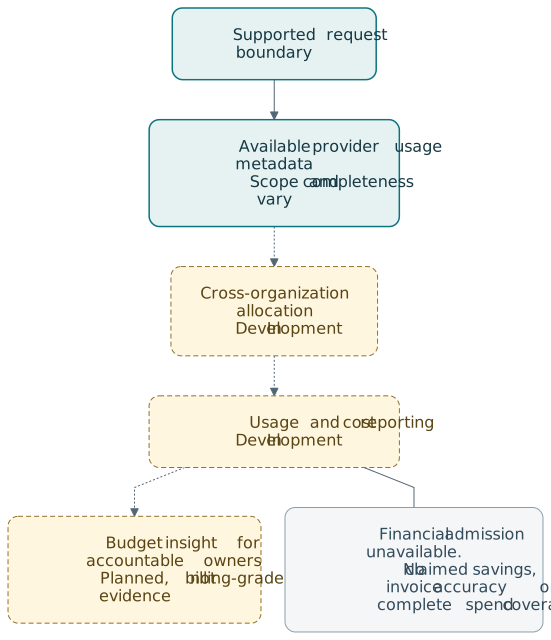
Provider usage metadata at a supported boundary is distinct from planned enterprise allocation, billing and financial controls.
Enterprise Tokenomics is In Development; financial admission is unavailable.
Read the diagram description
Provider usage metadata at a supported boundary is distinct from planned enterprise allocation, billing and financial controls. Enterprise Tokenomics is In Development; financial admission is unavailable.