
Governance dimensions
Gateway and enterprise egress governance
Distinguish the existing inline boundary from planned organization-wide network integrations.
In this document
What the Gateway can control#
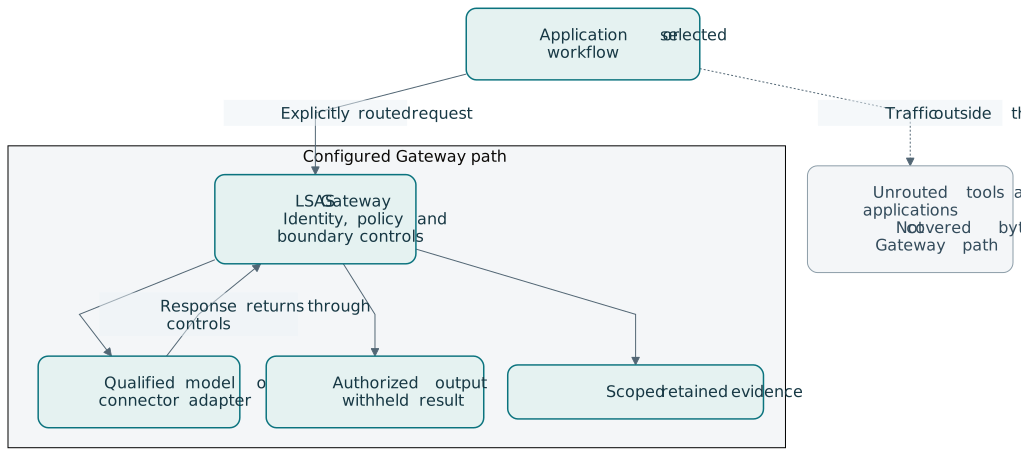
An application deliberately routes a supported request through the Gateway. LSAS resolves its identity and policy, evaluates ingress, invokes an admitted adapter where required and evaluates the output before release. The control exists at that routed boundary.
Traffic sent directly to an external AI service, through another proxy or by a disconnected application is outside that boundary unless another qualified integration covers it. An inline Gateway is not proof of enterprise network coverage.
What the enterprise egress design still needs#
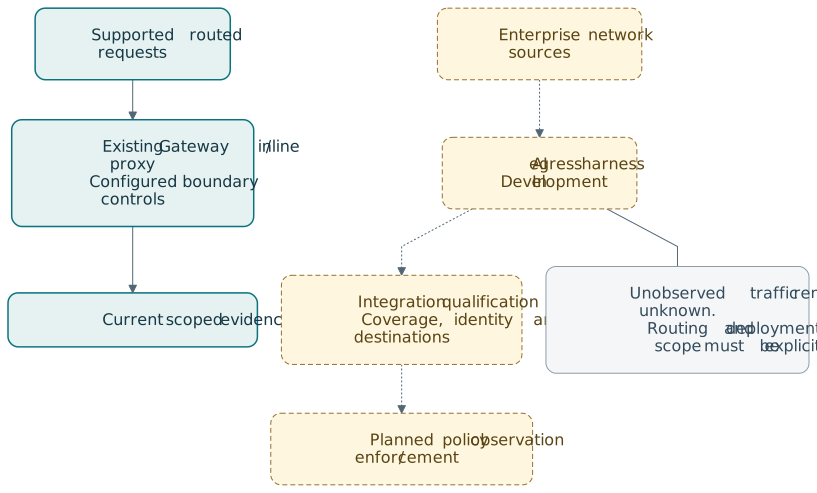
Broader network egress integrations remain In Development. Their design must establish which protocols can be observed, how application and user identity are attributed, how encrypted traffic is handled, and how approved destinations are maintained. These are integration-specific questions, not properties obtained simply by installing a dashboard.
A customer must also choose availability and failure behavior. The ability to hold a supported request does not establish that every network path can be safely intercepted or that a bypass-free topology has been qualified.
Make coverage evidence explicit#
For a routed request, retain the actual policy and final result. For a network observation, retain the observation source, time and attribution basis. Do not present an observed destination as proof that a content policy ran or that the receiving service completed the requested work.
- Registered: the asset is named in the agreed inventory.
- Observed: a qualified source reports relevant activity.
- Evaluated: supported content passed the policy boundary.
- Enforced: observed handling supports the stated control result.
Qualify one path first#
A useful pilot starts with one named application, one data boundary and one approved destination. Test ordinary traffic, denied destinations, cancellations, provider failure and policy changes. Extend coverage only when the new path has equivalent identity, enforcement and evidence semantics.
Only traffic routed through supported, configured Gateway paths receives those boundary controls. Other traffic is outside that enforcement path.
Supported inline/API placement; not organization-wide network interception.
Read the diagram description
Only traffic routed through supported, configured Gateway paths receives those boundary controls. Other traffic is outside that enforcement path. Supported inline/API placement; not organization-wide network interception.
The current Gateway supports configured request paths. Broader enterprise egress integrations require explicit development and customer qualification.
Enterprise network harness is In Development; no universal traffic coverage claim.
Read the diagram description
The current Gateway supports configured request paths. Broader enterprise egress integrations require explicit development and customer qualification. Enterprise network harness is In Development; no universal traffic coverage claim.
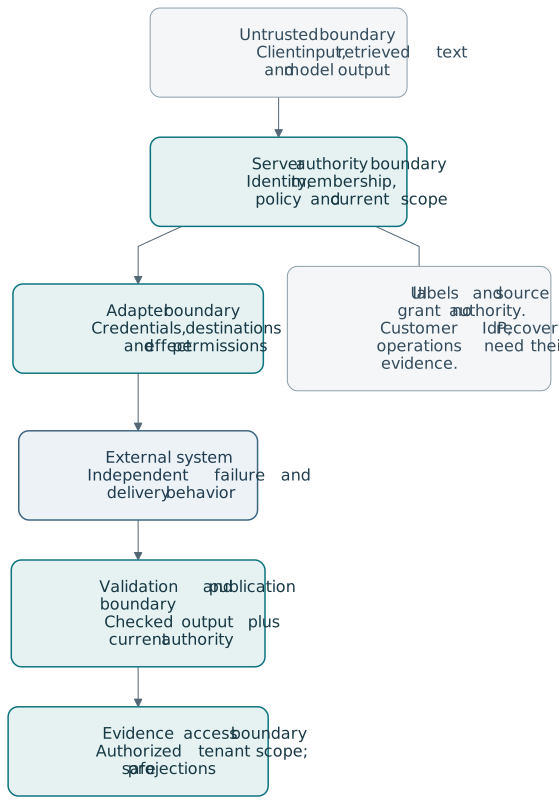
Untrusted clients and content cannot grant authority. Server authorization, qualified adapters and scoped evidence each have separate responsibilities.
Architecture boundaries; no certification or complete customer-environment qualification claim.
Read the diagram description
Untrusted clients and content cannot grant authority. Server authorization, qualified adapters and scoped evidence each have separate responsibilities. Architecture boundaries; no certification or complete customer-environment qualification claim.