
Organizational governance
Organizational Alignment
Author intent, obtain independent decisions and distinguish activation from execution.
In this document
Review the exact version#
Reviewers are assigned for distinct responsibilities. Decisions bind the proposal content and current assignment; an author cannot supply their own independent approval. Evidence references and attestations remain attributed and inspectable.
Readiness compares the selected saved proposal with actual current review decisions. A missing decision, stale assignment or changed content cannot be represented as ready merely because another version was approved. Activation is an explicit authorized command after the required checks.
Keep references descriptive#
System selectors expose authorized tenant applications and their environments. Guided references are checked again during save so that stale or foreign resources cannot be accepted as current. A referenced policy pack describes intended context; it does not assign that pack to runtime traffic.
A later resource change can produce a freshness warning. Such a warning is advisory unless the actual lifecycle command enforces that condition. Documentation and readiness displays must not invent additional activation gates.
Understand the current execution hold#
An active descriptive Alignment baseline does not yet supply a universal executable adapter for its conditions. Ordinary text and payload execution remains held when those semantics are unsupported. Runtime validation of approval integrity is necessary, but does not make every approved control enforceable.
Keep the approved organizational intent and a supported policy demonstration as separate evidence. A future executable mapping needs a reviewed interpretation, versioned technical implementation and observed control results.
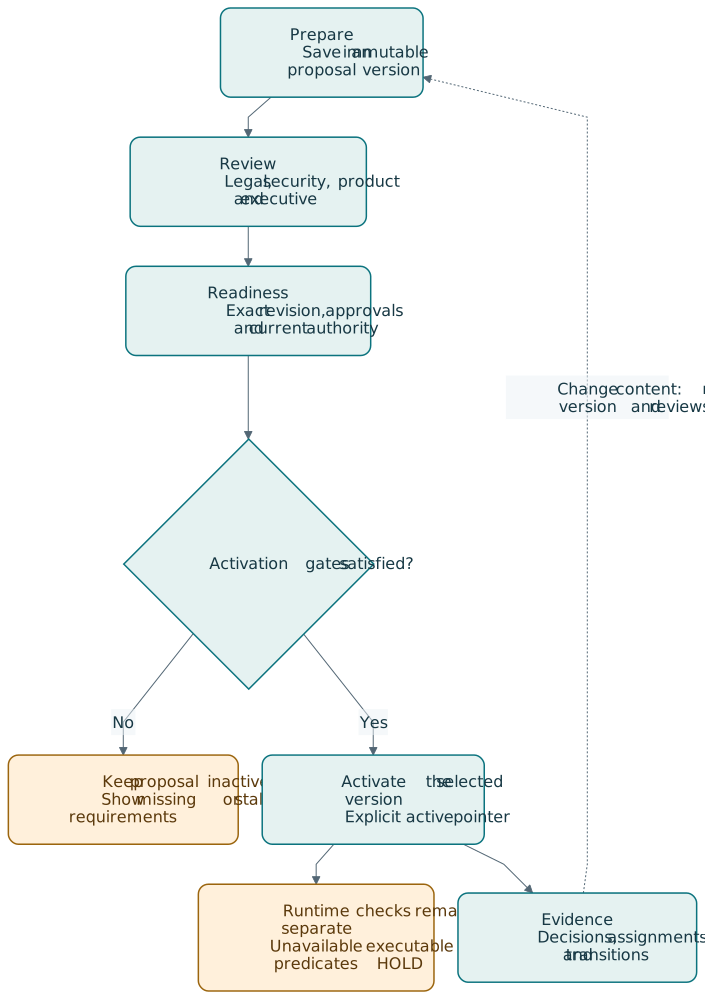
Prepare an immutable proposal, obtain independently assigned reviews, assess the exact version, and activate only through existing gates.
Current workflow; activation and runtime enforcement are separate checks.
Read the diagram description
Prepare an immutable proposal, obtain independently assigned reviews, assess the exact version, and activate only through existing gates. Current workflow; activation and runtime enforcement are separate checks.
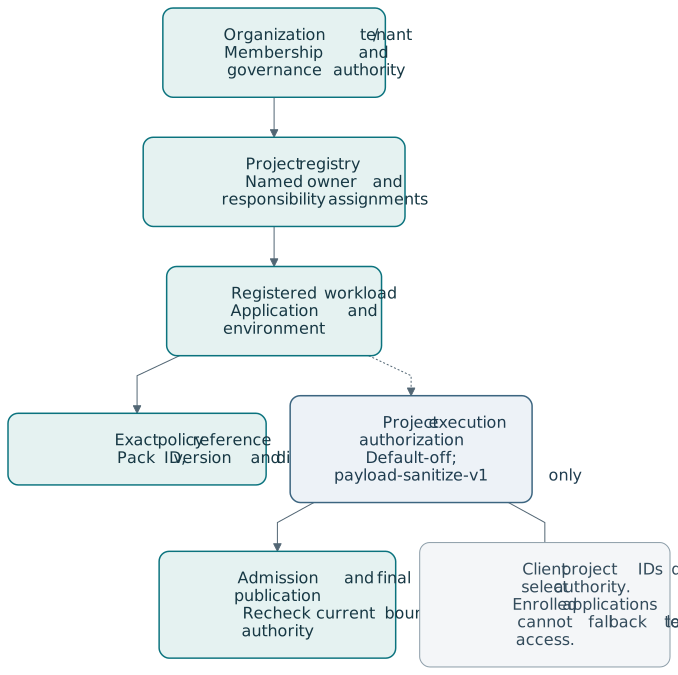
Organization, project, workload and exact policy references constrain interpretation; inventory alone never grants permission.
Registry is implemented; project execution authority is default-off and limited to payload-sanitize-v1.
Read the diagram description
Organization, project, workload and exact policy references constrain interpretation; inventory alone never grants permission. Registry is implemented; project execution authority is default-off and limited to payload-sanitize-v1.