
Enterprise operations
Enterprise scale and pilot measurement
Qualify the intended workload instead of treating illustrative scale as a benchmark.
In this document
Read the enterprise example correctly#
The enterprise-scale website view is an illustrative scenario. Its agent counts, outcomes, policy families and sample events explain how a portfolio view could work. They are not production telemetry, customer results or evidence that LSAS has operated at those volumes.
Modeled policy-assignment coverage describes an example assignment denominator. It does not establish observed assets, evaluated workloads, verified enforcement or regulatory compliance. Representative fictional sample events are not canonical execution receipts.
Define a representative qualification workload#
Specify applications, request shapes, content sizes, policies, adapters, concurrency, rate and evidence retention. Include both ordinary traffic and denied/held/error paths. Measure the actual deployed topology rather than extrapolating from a small contract fixture.
Latency and throughput need defined start/end points, periods and percentiles under documented conditions. Separate provider latency from governance overhead where instrumentation supports it. Event timestamps alone do not establish a reliable end-to-end duration.
Test failure behavior as part of capacity#
Qualification should verify that tenant isolation, current-authority checks and evidence publication remain correct under contention and interruption. Include cancellation, expiry, unavailable dependencies, recovery and retained evidence after restart. A fast response that bypasses a required control is not a successful benchmark.
Agree pilot acceptance before measurement#
Use the customer's baseline for evidence retrieval, manual review effort, traceability, workflow coverage and exception handling. Financial visibility is included only where a qualified integration supplies the required usage and rate provenance. Until a baseline exists, the result is measured during the pilot.
- Define the population and denominator.
- Name the collection method, frequency and owner.
- Record missing, unsuccessful and censored observations.
- Approve acceptance thresholds and limitations before comparing results.
Workload measurements, coverage and failure-mode evidence determine a justified operating envelope. Illustrations do not establish capacity.
Requires customer qualification; 100 / 3,000 / 30,000 profiles are illustrative, not benchmarks.
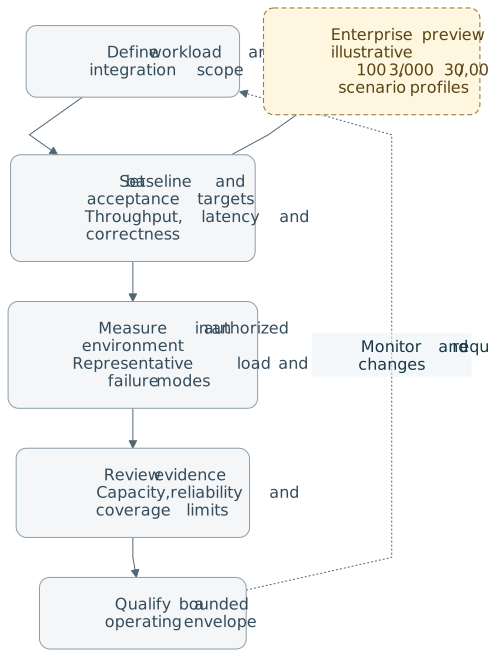
Read the diagram description
Workload measurements, coverage and failure-mode evidence determine a justified operating envelope. Illustrations do not establish capacity. Requires customer qualification; 100 / 3,000 / 30,000 profiles are illustrative, not benchmarks.
Reports share a retained, authorized relation while distinguishing totals, excerpts, unknown outcomes and event-time attribution.
Historical evidence uses recorded context, not current assignments; report scope and limits remain visible.
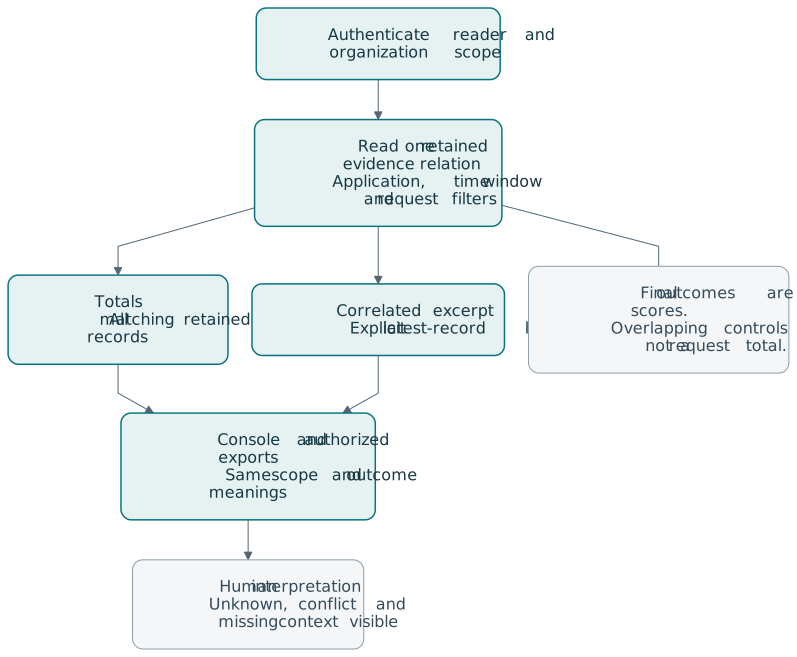
Read the diagram description
Reports share a retained, authorized relation while distinguishing totals, excerpts, unknown outcomes and event-time attribution. Historical evidence uses recorded context, not current assignments; report scope and limits remain visible.