
Governance dimensions
Operational Governance
Understand the expanding operating model and the limits of current visibility.
In this document
Connect operations to accountable use#
Operational Governance is the developing layer for understanding AI use across people, teams and managed workloads: which integrations are known, which traffic is observed, where policy is evaluated and what consumption can be attributed. It complements the compliance dimension rather than replacing organizational authority.
The network-oriented harness, enterprise AI egress integrations, Shadow AI Intelligence and Tokenomics remain In Development. Existing decision records show supported routed executions; they do not establish an enterprise-wide operating picture.
Separate inventory from enforcement#
A registered asset is known to the inventory. An observed asset has a qualified source of activity. An evaluated workflow passes a supported policy boundary. An enforced workflow additionally has verified technical handling. These are different levels of evidence.
A single observed integration event does not make a workflow fully governed. Unknown coverage should remain explicitly unknown. A percentage requires a named, maintained denominator and a qualification rule for each included asset.
Reuse what is already real#
The Gateway, scoped decision reporting, project registry and evidence projection provide useful foundations. Workbench telemetry publishes only an allowed demonstration scope and reports unavailable or stale data honestly. Those components can be extended when new integrations are qualified; a conceptual dashboard should not be substituted for their source records.
Define an operational pilot#
Start with a finite application and integration inventory. Specify observation sources, identity attribution, policy coverage and failure behavior. Measure the gap between registered, observed and enforced scope, and record what cannot yet be established.
- Use source-specific collection and freshness definitions.
- Keep consumption, estimated cost and billed cost distinct.
- Agree operating ownership and exception handling before expanding scope.
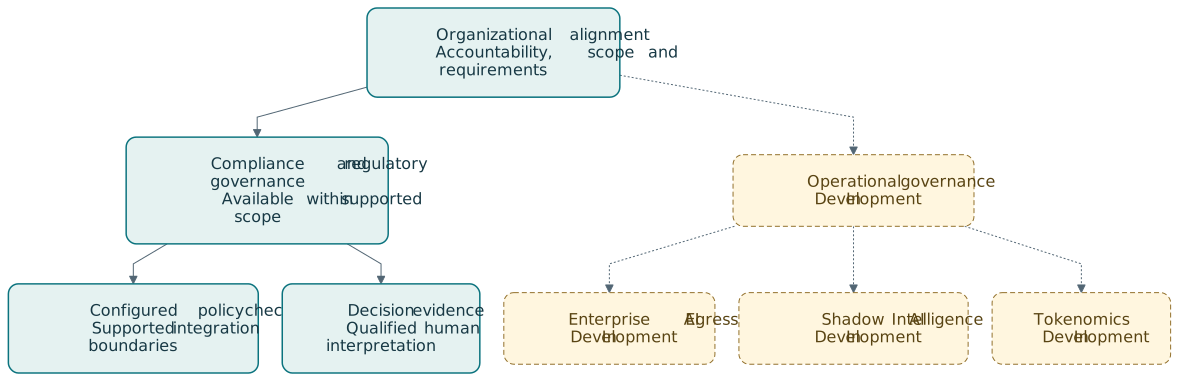
Compliance and regulatory governance uses scoped policies and evidence. Operational governance describes planned network, discovery and cost capabilities.
U.S.-first supported policy scope; no legal compliance certification.
Read the diagram description
Compliance and regulatory governance uses scoped policies and evidence. Operational governance describes planned network, discovery and cost capabilities. U.S.-first supported policy scope; no legal compliance certification.
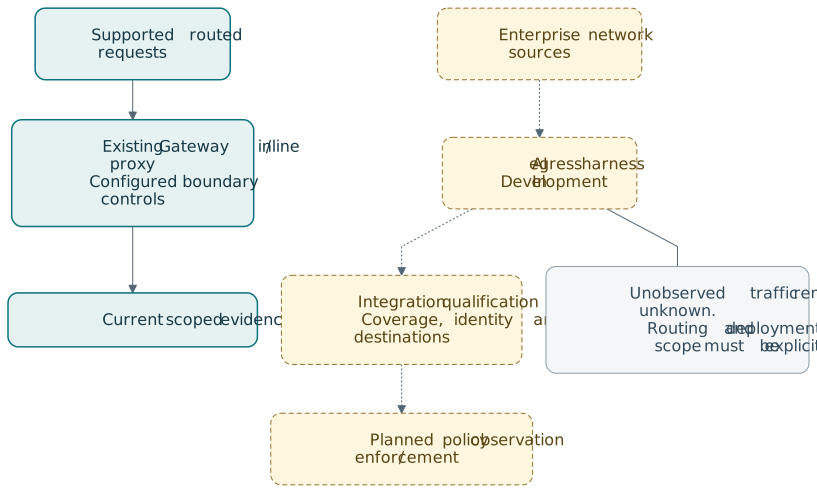
The current Gateway supports configured request paths. Broader enterprise egress integrations require explicit development and customer qualification.
Enterprise network harness is In Development; no universal traffic coverage claim.
Read the diagram description
The current Gateway supports configured request paths. Broader enterprise egress integrations require explicit development and customer qualification. Enterprise network harness is In Development; no universal traffic coverage claim.
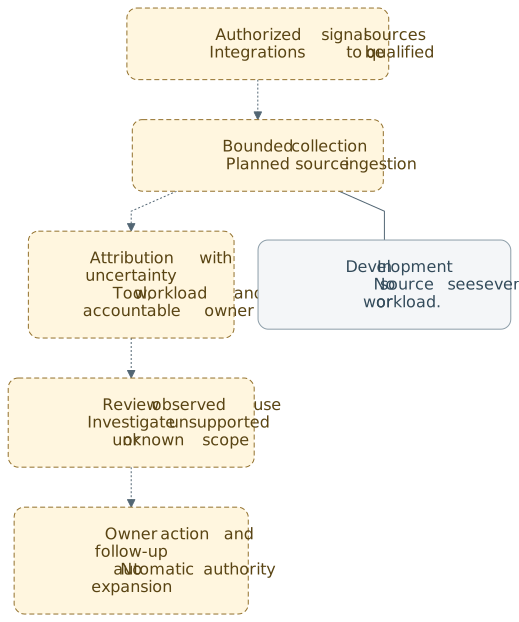
Planned discovery brings qualified signals into attribution and investigation; missing source coverage must remain visible.
In Development; this is a planned workflow, not a measured enterprise inventory.
Read the diagram description
Planned discovery brings qualified signals into attribution and investigation; missing source coverage must remain visible. In Development; this is a planned workflow, not a measured enterprise inventory.
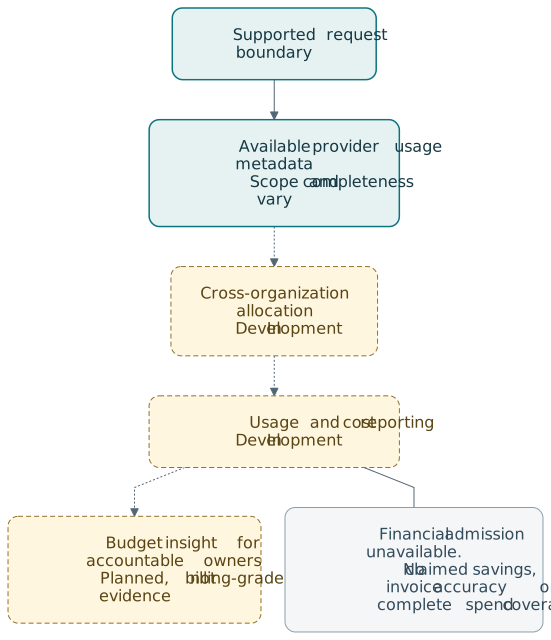
Provider usage metadata at a supported boundary is distinct from planned enterprise allocation, billing and financial controls.
Enterprise Tokenomics is In Development; financial admission is unavailable.
Read the diagram description
Provider usage metadata at a supported boundary is distinct from planned enterprise allocation, billing and financial controls. Enterprise Tokenomics is In Development; financial admission is unavailable.