
Enterprise operations
Development boundaries and next steps
See what is implemented, what is being developed and what needs a separate design decision.
In this document
Build on the existing foundation#
Current foundations include versioned Alignment, supported policy evaluation, bounded adapters, canonical evidence, structured assessment, a project registry, Workbench, Developer Evaluation, local Discovery and published state-source research. Their current limitations remain part of the product description.
The next work should extend these services and evidence models rather than duplicate them with an unrelated dashboard or a second authority history. A visually complete feature still needs its own functional and qualification evidence.
Capabilities still in development#
Operational Governance includes the planned network harness, enterprise egress integrations, Shadow AI Intelligence and Tokenomics. Expanded Self AI, Team AI and Managed AI profile configuration and contextual reporting are also unfinished.
Project-bound execution and delegated administration have controlled implementation behind default-off enablement. Their current scope is deliberately narrow. Reduced-review policies, broad executable Alignment semantics and unrestricted agent/tool orchestration are not obtained by turning on those controls.
Separate future design decisions#
Financial admission needs agreed monetary authority, usage/rate provenance, reservation and settlement semantics. Jurisdiction-aware execution needs reviewed applicability and installed, qualified technical controls. Authoritative retrieval and model-based assessment require their own source and provider boundaries.
Federal or international regulatory expansion, air-gapped deployment and general enterprise capacity must each be established by concrete implemented scope and evidence. They are not announced as available here.
Choose the next increment by its proof#
A useful next step names one buyer problem, one supported integration and one measurable acceptance result. Document the baseline, owner, required evidence, failure cases and remaining coverage. Use a scoped Discovery or pilot conversation to agree that work. Roadmap descriptions are direction, not delivery dates, contractual commitments or current entitlements.
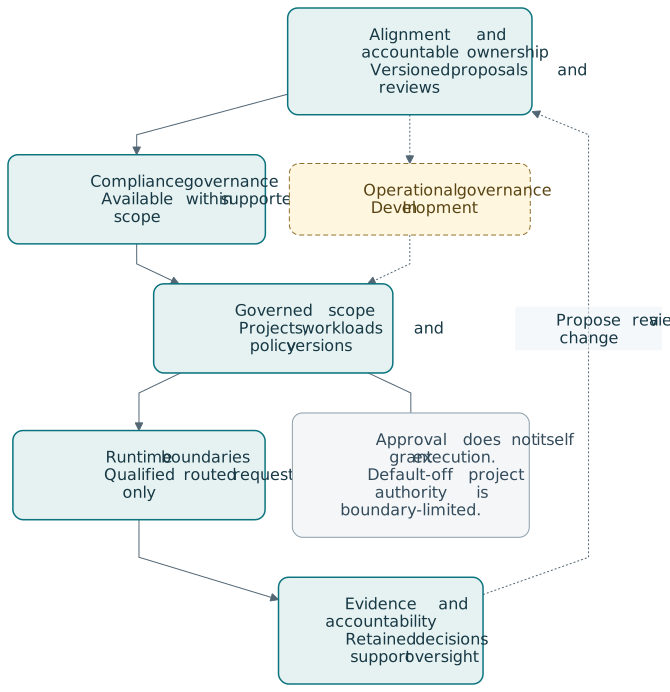
Organizational alignment and accountable scope connect to supported runtime controls and retained evidence. Operational extensions remain in development.
Conceptual relationship; organizational approval is not executable enforcement.
Read the diagram description
Organizational alignment and accountable scope connect to supported runtime controls and retained evidence. Operational extensions remain in development. Conceptual relationship; organizational approval is not executable enforcement.
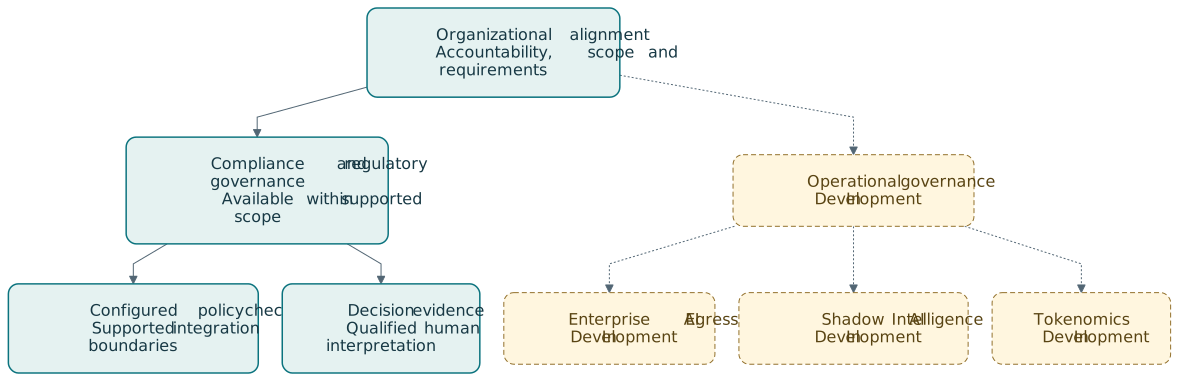
Compliance and regulatory governance uses scoped policies and evidence. Operational governance describes planned network, discovery and cost capabilities.
U.S.-first supported policy scope; no legal compliance certification.
Read the diagram description
Compliance and regulatory governance uses scoped policies and evidence. Operational governance describes planned network, discovery and cost capabilities. U.S.-first supported policy scope; no legal compliance certification.
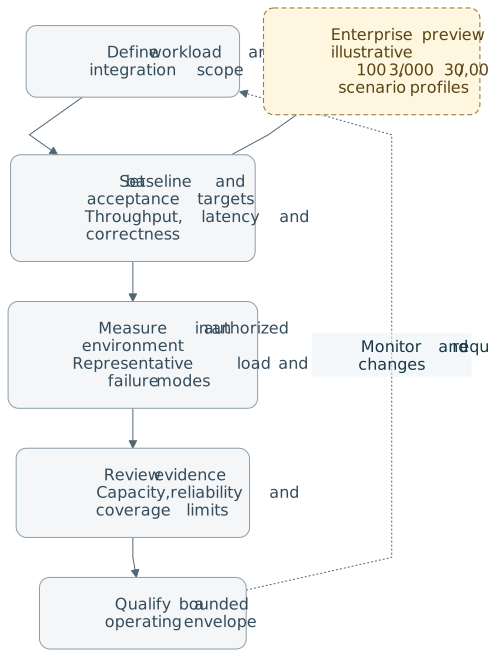
Workload measurements, coverage and failure-mode evidence determine a justified operating envelope. Illustrations do not establish capacity.
Requires customer qualification; 100 / 3,000 / 30,000 profiles are illustrative, not benchmarks.
Read the diagram description
Workload measurements, coverage and failure-mode evidence determine a justified operating envelope. Illustrations do not establish capacity. Requires customer qualification; 100 / 3,000 / 30,000 profiles are illustrative, not benchmarks.
Assurance context: Vanta’s audit process explanation (source checked November 6, 2026). Early Vanta discussions are company-provided context; they do not establish an audit or attestation.
Help shape the next boundary.
Roadmap directions carry no promised delivery date. Discuss the use case, required controls and evidence for your environment.
Discuss this capability →