
Organizational governance
Self AI, Team AI and Managed AI
Apply proportionate governance to personal use, shared work and managed execution.
In this document
Three ways AI enters an organization#
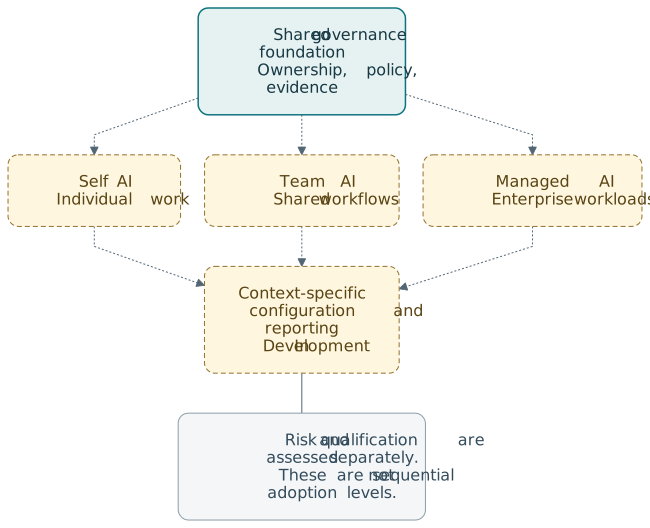
Self AI describes an individual using AI within an agreed purpose and data boundary. Team AI describes shared workflows, common knowledge and collective responsibilities. Managed AI describes applications or workloads operated with explicit integration and service ownership.
These are adoption contexts, not pricing tiers, permission levels or product editions. The same organization may use all three. Classifying a use case does not automatically discover its tools or apply controls to its traffic.
Match the control to the work#
Start with the effect an AI system can have: what information it can receive, what it may produce, which destinations it may reach and who can accept the result. A low-impact drafting workflow and an automated external action need different control and evidence requirements.
Use Alignment to make those responsibilities reviewable. Use a supported integration to evaluate the actual request or artifact. Keep a clear statement of what sits outside that boundary rather than claiming coverage for every participant.
Current implementation status#
Expanded Self AI, Team AI and Managed AI profile configuration and contextual reporting remain In Development. Current evaluations demonstrate a limited set of supported workflows. A context card or enterprise illustration is not a released inventory or an applied policy configuration.
- Self AI: establish permitted data, purposes and escalation expectations.
- Team AI: identify shared workflow ownership, source responsibilities and evidence needs.
- Managed AI: identify the application, environment, integration boundary and operating owner.
Build a shared governance agreement#
Agree the use case, accountable people, known integrations, technical control and acceptance evidence before expanding deployment. Revisit that agreement when a tool, data class, workflow effect or responsible person changes. Organizational Alignment is the existing path for recording that intent; the adoption label alone provides no execution authority.
Self AI, Team AI and Managed AI describe operating contexts, not maturity steps, risk ratings or subscription tiers.
Profile configuration and contextual reporting are In Development.
Read the diagram description
Self AI, Team AI and Managed AI describe operating contexts, not maturity steps, risk ratings or subscription tiers. Profile configuration and contextual reporting are In Development.