
LSAS Platform / Evidence Packet
Don’t just trust the decision. Inspect the evidence.
Recorded decisions. Traceable controls. Reviewable artifacts. LSAS Platform assembles retained governance evidence into structured reports—with the policy versions, execution observations and coverage limits a reviewer needs to examine what happened.
A public demonstration for engineering, governance, security and assurance review. Synthetic execution. No customer evidence.
A decision you can examine.
Observed in this synthetic-provider request.
- Policy decision
- BLOCKED
- Final release outcome
- BLOCKED
- Exact policy version
developer-data-guard@1.0.0- Enforcement boundary
- Recorded ingress control
- Request correlation · public alias
30000000-0000-4000-8000-000000000001- Synthetic-provider calls
- 0 recorded calls
"providerCalls": 0
"outcome": "BLOCKED"
From assertion to examination
Governance is more credible when it can be examined.
A dashboard can summarize a result. An evidence packet lets another person examine the records behind it—and understand where their conclusions must stop.
- Inspectability
Examine the recorded policy result, applied boundary and supporting execution observations.
- Traceability
Follow exact policy versions, request references and retained timestamps across the packet.
- Accountability
Look for actual ownership and historical authority references. Their absence stays visible.
- Handoff
Bring appropriately authorized records into a review without requiring every recipient to operate LSAS Platform.
- Assurance with boundaries
Distinguish exercised controls from configured or unobserved capabilities. A professional deliverable should make uncertainty easier to see.
Examine the recorded result
One packet. Six ways to inspect it.
Move from the executive summary to a specific request, its observed controls and the underlying structured record. Limitations are a first-class view.
Synthetic environment · Schema 2 · Public aliases
One retained evaluation. Multiple evidence layers.
Recorded outcomes and boundary observations from a controlled synthetic environment, presented without upgrading them to production assurance.
Final release outcomes
- 2RELEASED
- 0TRANSFORMED
- 2BLOCKED
- 0HELD
A policy decision, action grant and final release are separate records—not interchangeable success signals.
- Source export generated
- 2026-11-07 06:58:36.404 UTC
- Coverage
- Complete retained evaluation history; not enterprise coverage
- Policy
developer-data-guard@1.0.0- Evidence window (UTC)
- 2026-10-27 18:46:48.707 UTC
to 2026-10-29 18:40:14.411 UTC
Curated synthetic records. No production qualification implied.
Download sample packet ↓A coordinated artifact family
From recorded execution to reviewable evidence.
These are working views and downloads from the same sanitized export—not separate examples assembled to tell different stories.
Developer Evaluation
Executive evidence brief
Four retained requests under one policy version. Two final outputs authorized for release, two blocked at ingress before synthetic-provider dispatch.
Includes technical decision records, observed control coverage, provenance and the limits of the synthetic environment. Organizational approvals and external delivery are not established.
Open the actual PDF reportSummary preview above; the PDF uses the existing LSAS evaluation report generator.
Technical evidence reportOpen the complete HTML report: coverage, policy references, decisions, action observations and explicit limitations.
- Policy / version
developer-data-guard@1.0.0- Policy → boundary → final outcome
- BLOCKED → ingress → BLOCKED
- Synthetic-provider calls
- 0
Audit & provenanceInspect correlated decision IDs and timestamps. The sample contains decision references, not a complete audit-event stream.
- Request correlation · public alias
30000000-0000-4000-8000-000000000001- Decision event · public alias
40000000-0000-4000-8000-000000000001- Recorded timestamp
- 2026-10-29T18:40:14.411Z
- Audit event stream
- Not included in this evaluation export.
Structured JSONDownload the authentic schema 2 envelope with all four sanitized records and derived control coverage.
Exact selected record excerpt · full schema 2 JSON available below.
{
  "requestId": "30000000-0000-4000-8000-000000000001",
  "decision": "BLOCKED",
  "outcome": "BLOCKED",
  "stage": "ingress",
  "scenario": {
    "id": "block-input",
    "mode": "synthetic-provider",
    "providerCalls": 0,
    "inputWasCustomized": false,
    "ingress": {
      "decision": "BLOCKED",
      "outcome": "BLOCKED"
    }
  }
}Evidence manifestInspect the artifact inventory, byte sizes and SHA-256 checksums for this public sample package.
- evidence.json
- 18,550 bytes · SHA-256 recorded
- report.html
- 59,491 bytes · SHA-256 recorded
- report.pdf
- 128,485 bytes · SHA-256 recorded
- README.txt
- 4,613 bytes · SHA-256 recorded
- verify.mjs
- 3,126 bytes · SHA-256 recorded
Scope & verification guidanceRead the curation method, evidence limits and instructions for the included local file-checksum verifier.
- Synthetic execution
- These records describe deterministic content checks, a synthetic provider and a fixed synthetic reader. No external model or arbitrary tool was invoked.
- Release is not delivery
- RELEASED records final boundary authorization. It does not prove delivery to an intended recipient or a completed business transaction.
- Observation is not configuration
- A configured validator or control is not necessarily exercised by these requests. NOT_OBSERVED is not a failure, and NOT_RECORDED is never ALLOW.
Inspect the exact-file manifest
SHA-256 of the exact file bytes, before ZIP packaging. The manifest does not hash itself; there is no digital signature or independent attestation. The included verifier checks local files against this manifest.
- evidence.json
- 18,550 bytes · application/json
SHA-256 9f240c4006fdf7142a63926b50f3048bf57770c9600a3bead298d2fc3ac0862e - report.html
- 59,491 bytes · text/html
SHA-256 222446b5d7feed563983894447521108118f57bb47748801bf27d0b3d93cd4ff - report.pdf
- 128,485 bytes · application/pdf
SHA-256 8c713e04c7df1894dfb4bf542243d243389ffedd346e95fd018e4e8dd347383a - README.txt
- 4,613 bytes · text/plain
SHA-256 ec3822efc77b7ea801edaf8a54f9faec3622f3c175c9667e01d8f0e10a9a9ece - verify.mjs
- 3,126 bytes · text/javascript
SHA-256 5021fba9f63c03e1d4c1fe18132dd5bff37100f5c76e801172145dc895cdc89a
Public synthetic artifacts only. No registration required.
The evidence architecture
From governed execution to an authorized handoff.
Assembly organizes what was retained. It does not recreate missing history, confer review authority or make a recipient-sharing service available.
Policy evaluation, observed controls and final release remain distinct.
Decision records and permitted audit excerpts; missing history stays missing.
Existing exports organize the retained records and disclose coverage.
Interpret the evidence; external sharing requires separate authorization.
Inspect the complete architectural diagram
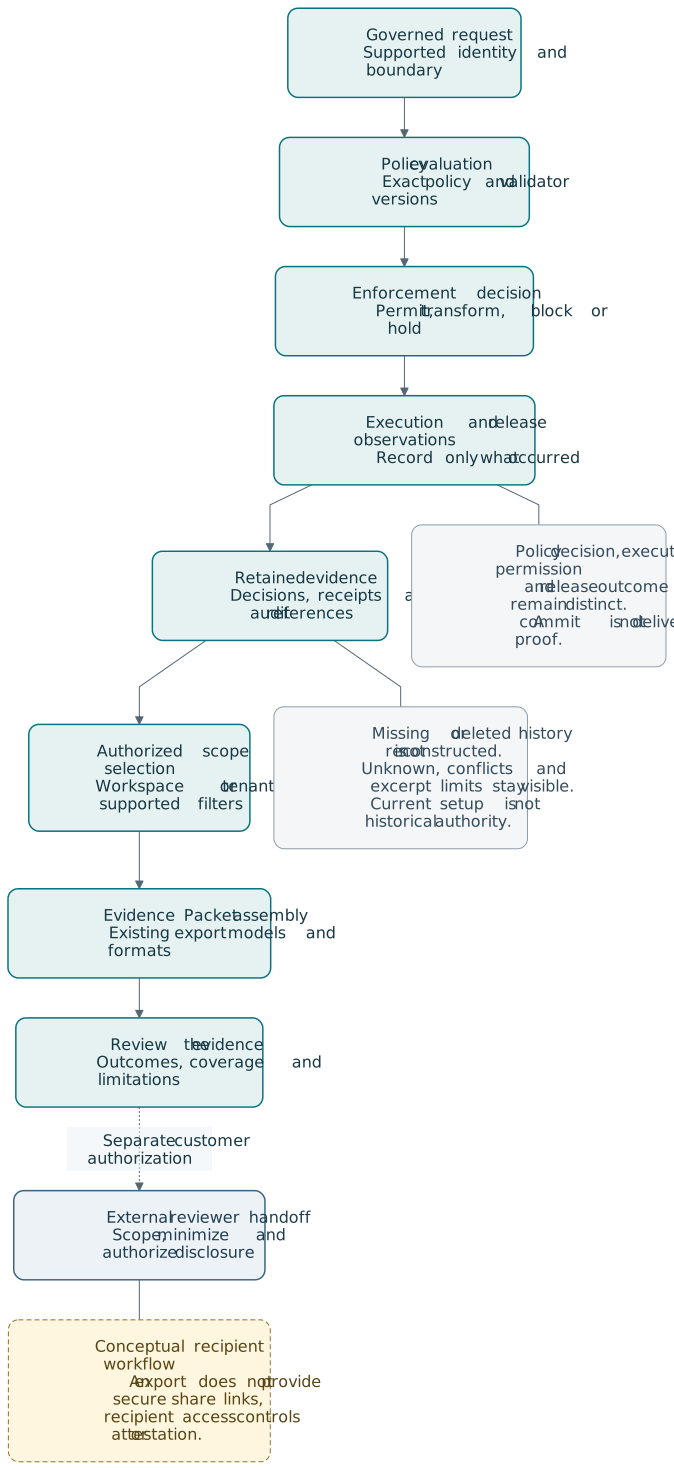
Retained decisions and audit sources → authorized selection → evidence assembly → review. Missing records, truncated excerpts and unavailable historical authority remain explicit.
Audience, scope and permission
Evidence designed to travel beyond the platform.
A governance team or advisor can use authorized records alongside an assessment, procurement response or incident review. The ability to download evidence does not grant permission to disclose it.
Public sample
This curated packet is available to inspect and download. Identifiers are public aliases; the environment and observations remain explicitly synthetic.
Customer internal
Existing authenticated evaluation and tenant exports assemble retained evidence under their current access rules. Audit visibility, selected scope, retention and excerpt limits still apply.
External reviewer
Recipient-specific packets, expiring links and external reviewer access are not provided here. External handoff requires separate authorization and appropriate minimization.
A deliverable for the next reviewer
Bring the right evidence into the right conversation.
A packet supports professional judgment. Select the permitted scope, explain the collection boundary and keep unverified conclusions separate from recorded facts.
- Executive and project review
Examine selected outcomes, accountable ownership where recorded, and unresolved evidence gaps before the next deployment decision.
- Security and engineering assessment
Correlate policy versions, observed controls and final release outcomes. Use the actual records to investigate exceptions.
- Audit preparation and compliance review
Supply authorized retained records and coverage disclosures as supporting material. The packet is not an audit opinion or certification.
- Customer assurance and procurement
Share an appropriately minimized technical evidence deliverable under your organization’s approval process. This page does not grant external access.
- Advisory and consulting engagements
Include permitted LSAS-generated evidence alongside your own assessment and recommendations. Reviewer conclusions remain distinct from system observations.
Know what the evidence supports
Evidence is strongest when its boundaries are explicit.
Policy decisions, observed execution, release outcomes and reviewer conclusions answer different questions. Keep them separate.
Four recorded requests, one exact policy version. Complete refers to four retained records out of four lifetime records in the supplied snapshot; it is not suite coverage, regulatory compliance, accuracy or production readiness.
- Synthetic execution
These records describe deterministic content checks, a synthetic provider and a fixed synthetic reader. No external model or arbitrary tool was invoked.
- Release is not delivery
RELEASED records final boundary authorization. It does not prove delivery to an intended recipient or a completed business transaction.
- Observation is not configuration
A configured validator or control is not necessarily exercised by these requests. NOT_OBSERVED is not a failure, and NOT_RECORDED is never ALLOW.
- Review is a separate record
An escalation decision does not establish completed human review. This packet contains no organizational approval or historical Alignment authority reference.
- Scope is the retained set
This is one curated four-request Developer Evaluation export, not estate-wide coverage, four distinct test cases or a fresh benchmark.
- Integrity is not attestation
File checksums detect differences from the supplied manifest. They do not establish signer identity, independent authenticity or tamper-proof history.
One evidence foundation
Follow the records across LSAS Platform.
Workbench demonstrates supported controls. Developer Evaluation records technical assessment results. The authenticated console maintains scoped governance records. Packets organize retained information for review.
From evidence to a scoped evaluation
See what your governance evidence could look like.
Inspect the sample, try a governed result, or discuss the records and integration boundaries your application or enterprise pilot needs.
Return to the sample inspector