
Organizational governance
Projects and accountable ownership
Record who is responsible without silently granting execution or financial authority.
In this document
Register a purpose and an owner#
A project has a stable identity, a name and purpose, and one accountable current tenant member. Technical, governance, sponsor and finance responsibilities can be recorded separately. These fields explain responsibility; they are not new permission roles.
The registry initially represents draft projects. Managers can manage the tenant's records, while responsible members have scoped read access. A project record does not prove that its workload is observed, governed or permitted to execute.
Bind declared scope carefully#
An application/environment reference connects a project to a known workload. Revision checks prevent a stale editor from silently replacing newer changes, and the service and database enforce the supported uniqueness rules. Changes are retained in append-only history.
An exception response can refer to actual original assessment evidence and record an accountable owner, status and supporting response. Closing that record does not rewrite the finding or turn a past BLOCKED or HELD result into a release.
Read event-time accountability#
Where a supported execution records project context, the evidence preserves the context at the event time. Later owner or policy changes do not rewrite the historical record. Legacy decisions without this context remain unattributed; the system must not assign them to today's owner by inference.
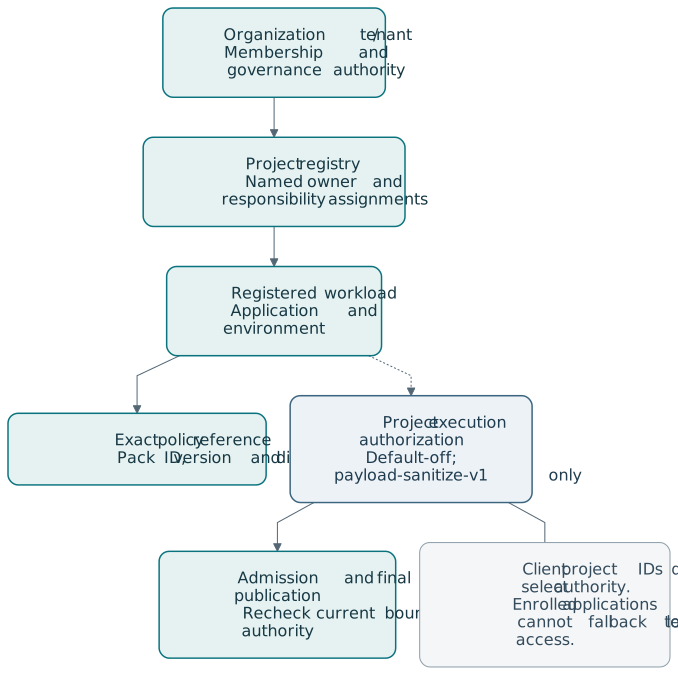
Organization, project, workload and exact policy references constrain interpretation; inventory alone never grants permission.
Registry is implemented; project execution authority is default-off and limited to payload-sanitize-v1.
Read the diagram description
Organization, project, workload and exact policy references constrain interpretation; inventory alone never grants permission. Registry is implemented; project execution authority is default-off and limited to payload-sanitize-v1.
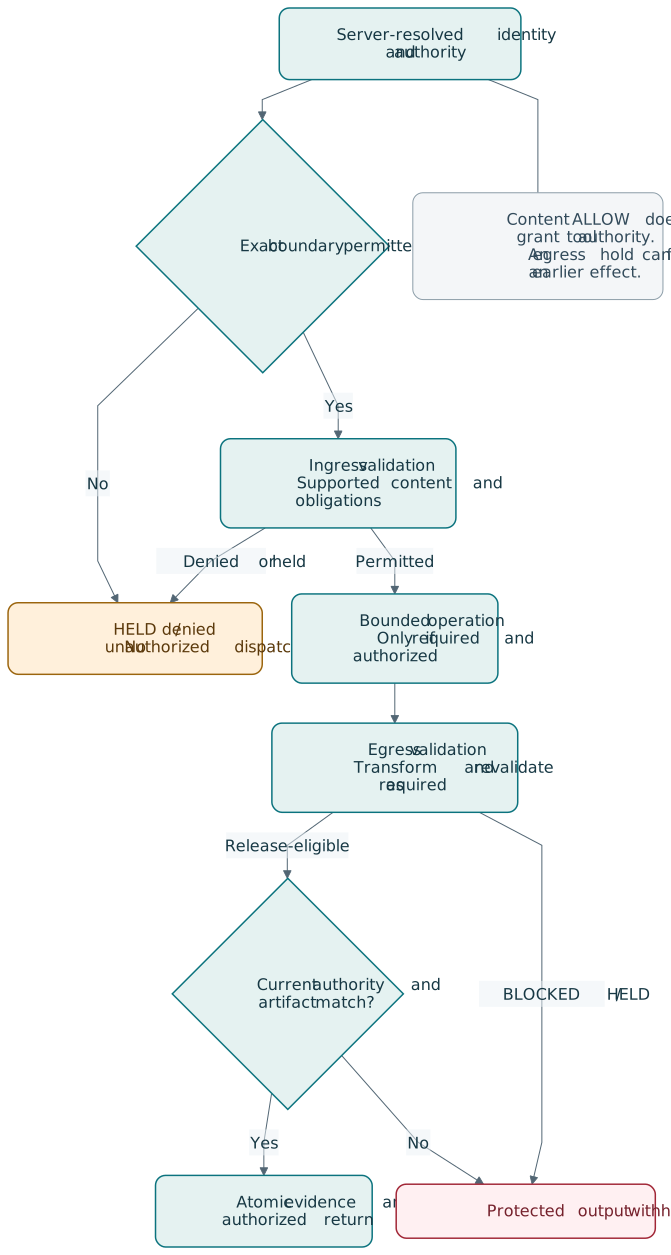
Execution authority, content policy and final publication are separate gates; a hold never becomes permission through a UI override.
Current supported boundaries; public teaching simulations do not resume real effects.
Read the diagram description
Execution authority, content policy and final publication are separate gates; a hold never becomes permission through a UI override. Current supported boundaries; public teaching simulations do not resume real effects.