
Evaluation & intelligence
Developer Evaluation
Obtain a governed result through a bounded private technical evaluation.
In this document
Understand the evaluation workspace#
Developer Evaluation is separate from the public Workbench. Where enabled, verified enrollment creates a private managed evaluation context with a scoped key, supported policy choices and owner-scoped evidence. Existing activation, duration, quota and expiry rules apply.
The managed workspace is intentionally constrained. Evaluation access does not permit arbitrary production configuration, unrestricted model-provider calls, clinical use or unlimited agent execution. Use synthetic or non-sensitive data.
Run a supported exercise#
Choose a supported policy and download its current exercise or application kit. The deterministic payload path demonstrates release, transformation and withholding without a model call. Fixed scenario paths use an explicit recording provider. Supported action exercises use a finite server-controlled action set and local callback behavior.
Keep the expected result separate from the observed result. A deliberately incorrect expectation should fail the exercise while preserving the actual policy outcome. The kit must not rewrite an observed ALLOW into a BLOCK merely to satisfy a test.
Reconcile output and retained evidence#
Inspect the actual HTTP result, policy and validator versions, request identity and final artifact hash where present. Compare owner-scoped detail and export records. Existing exercises qualify ownership, malformed input, quota, expiry and suspension behavior alongside successful outcomes.
A report or download is not itself an execution. Event definitions distinguish evaluation activation, a policy scenario result, evidence inspection and exported evidence. Do not infer a completed application transaction from an allowed policy decision.
Move to a scoped integration#
Bring a representative workflow, intended data classes, destinations, operating owner and acceptance criteria to a Discovery or pilot discussion. The next step is qualification of a specific integration, not automatic conversion of an evaluation key into production authority. Pricing and engagement terms remain on the complete Pricing page.
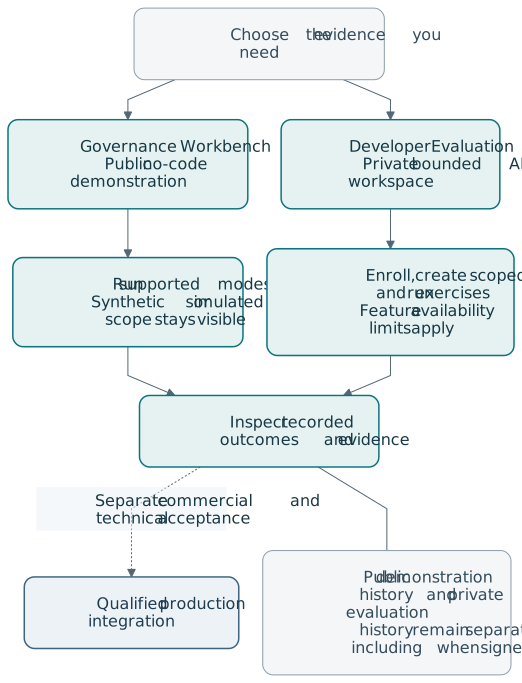
Governance Workbench is a public demonstration context; Developer Evaluation is a separate private, bounded API experience.
Neither free path grants production entitlement or is a prerequisite for the other.
Read the diagram description
Governance Workbench is a public demonstration context; Developer Evaluation is a separate private, bounded API experience. Neither free path grants production entitlement or is a prerequisite for the other.