
Runtime & evidence
Reporting and accountable follow-up
Use consistent populations, final outcomes and explicit measurement limits.
In this document
Start with the report population#
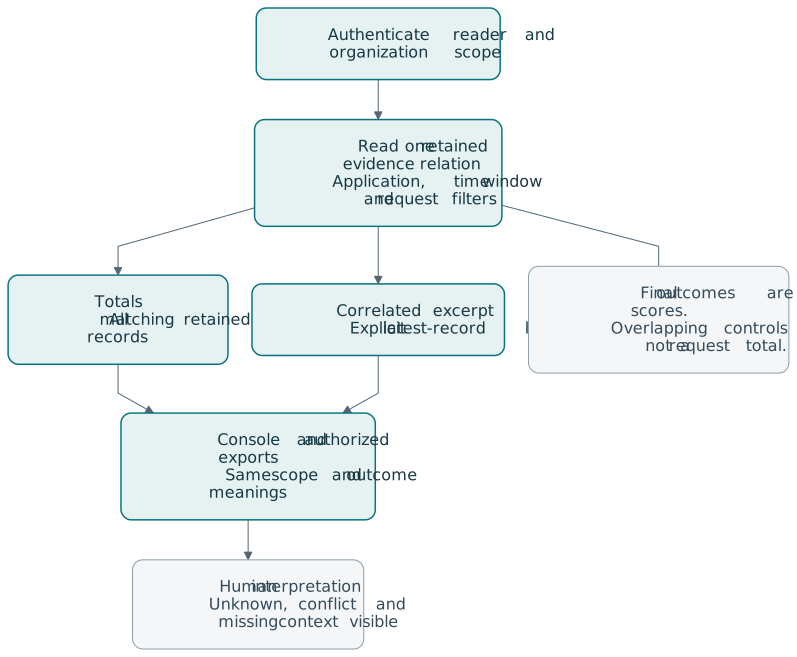
Tenant reporting uses an authorized application and time-window projection. Totals describe retained matching records; detail views may show a bounded recent excerpt. Read the window and excerpt limit rather than assuming the visible rows are the entire denominator.
Canonical decisions and qualified historical connector records are correlated and deduplicated. Missing terminal evidence remains unknown; conflicts are identified rather than repaired by guessing. A configuration audit event does not become a runtime release outcome simply because it appears in the same timeline.
Assessment and execution answer different questions#
A structured governance assessment evaluates supported case fields and records findings. It can support review and accountable exception follow-up. Structural evidence checks establish the presence and shape of references, not their factual correctness or the clinical safety of a conclusion.
A runtime receipt records handling of an actual supported request. Keep these evidence classes separate in executive summaries. Closing an assessment exception records the response and supporting evidence; it does not alter the original result.
Interpret demonstration telemetry#
Workbench telemetry is publication-scoped demonstration data. It must not merge a signed-in user's private tenant history into a public view. Inspect source, period and freshness; an unavailable panel should remain unavailable, not display a fabricated current value.
Demonstration streams may contain different provenance, including synthetic and simulated behavior. Do not combine them into a production-performance or customer-value claim. A policy block count is not a breach-prevention count.
Define a pilot measurement#
Useful measures include evidence retrieval time, decision traceability, manual review effort, covered workflow inventory and exception response. Each needs a baseline, collection period, owner, formula and acceptance criterion. Report missing observations and incomplete tasks rather than dropping them from a favorable average.
- Traceability denominator: decisions for which the named provenance is applicable.
- Coverage denominator: an agreed inventory, not the number of events seen.
- Time measure: defined start/end events, with unsuccessful or censored attempts separate.
Reports share a retained, authorized relation while distinguishing totals, excerpts, unknown outcomes and event-time attribution.
Historical evidence uses recorded context, not current assignments; report scope and limits remain visible.
Read the diagram description
Reports share a retained, authorized relation while distinguishing totals, excerpts, unknown outcomes and event-time attribution. Historical evidence uses recorded context, not current assignments; report scope and limits remain visible.