
Runtime & evidence
Evidence and execution receipts
Read what a result proves, how it was produced and where its authority ends.
In this document
Inspect the decision and the final outcome#
Start with the request identity, committed timestamp, effective policy ID/version and validator provenance. Compare the engine decision with the final handling: RELEASED, TRANSFORMED, BLOCKED or HELD. Ingress and egress can differ, so preserve their stages.
For a released artifact, the supported digest convention binds the serialized artifact. An observed response, owner-scoped detail record and export should agree. Contradictory or missing final records cannot support a verified outcome merely because an earlier policy check passed.
Preserve the context at the event time#
Where project execution is supported, the canonical record includes the exact event-time authorization context. A later ownership, policy or membership change does not rewrite it. Records without qualified project context remain unattributed.
An evidence export uses the authorized scope and shared report projection. Verify its time window, filters, total count and excerpt limit before using it in an assessment. A sample excerpt is not the full population even when it contains convincing examples.
Classify the evidence correctly#
The public execution demonstration is measured using synthetic test data and a fixed recording provider. Its manifest identifies source versions, run period, definitions and limitations. The enterprise-scale preview is an illustrative example; its numbers are not measurements.
A hash detects content differences under its stated serialization rule. It is not a signature, independent attestation, proof of source truth or anonymization. Evidence completeness means defined fields and agreement, not regulatory compliance.
Export only the intended evidence#
Ordinary derived decision evidence is different from submitted case material, connector diagnostic snapshots and encrypted exact-output review artifacts. Each has a distinct access and retention boundary. Do not assume that every storage table is raw-content-free, or broaden diagnostic authority merely to make a report more detailed.
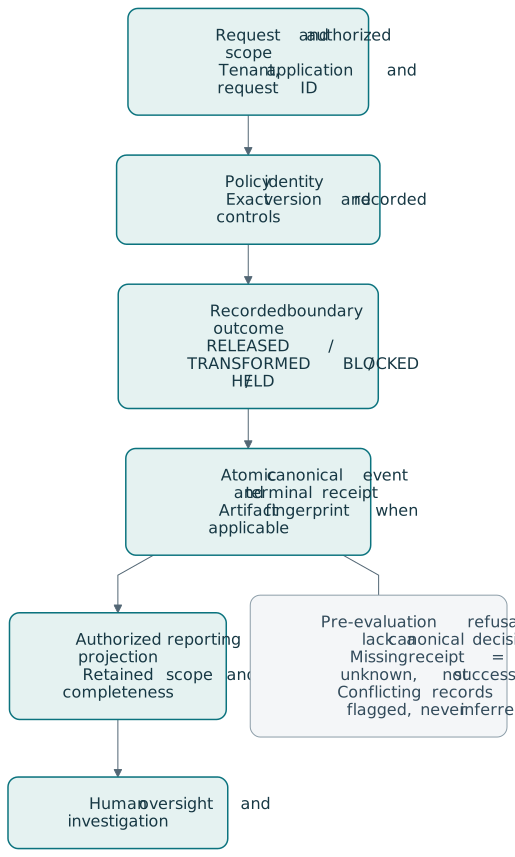
A request identity links the exact policy, recorded boundary outcome and artifact fingerprint to retained reports. Intermediate events do not establish release.
Evidence integrity within retained scope; transaction commit is not downstream delivery.
Read the diagram description
A request identity links the exact policy, recorded boundary outcome and artifact fingerprint to retained reports. Intermediate events do not establish release. Evidence integrity within retained scope; transaction commit is not downstream delivery.
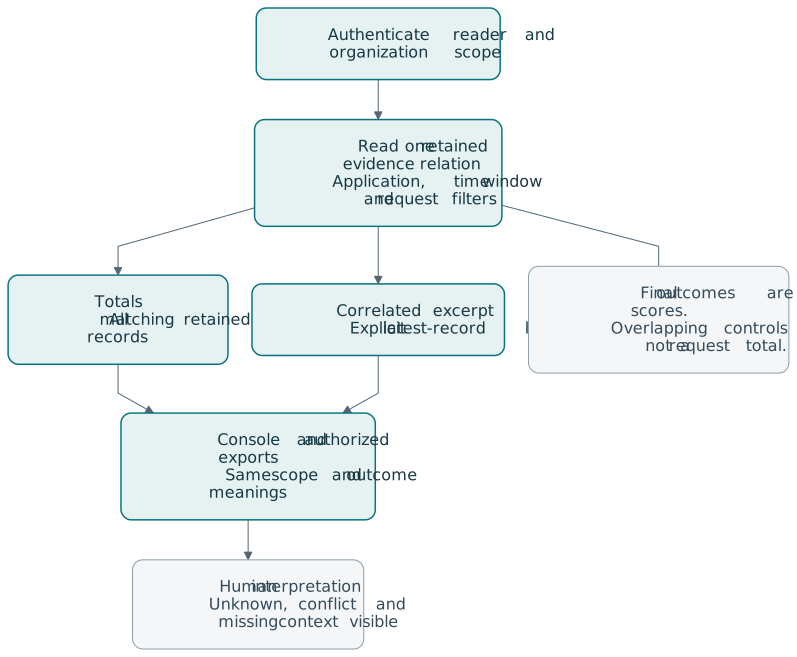
Reports share a retained, authorized relation while distinguishing totals, excerpts, unknown outcomes and event-time attribution.
Historical evidence uses recorded context, not current assignments; report scope and limits remain visible.
Read the diagram description
Reports share a retained, authorized relation while distinguishing totals, excerpts, unknown outcomes and event-time attribution. Historical evidence uses recorded context, not current assignments; report scope and limits remain visible.