
Foundations
What LSAS Platform governs
Connect organizational intent, supported execution controls and inspectable evidence without confusing their boundaries.
In this document
Start with a decision that matters#
LSAS Platform connects governance decisions to technical control points and evidence. A team first defines the work, the accountable people and the permitted boundary. Supported integrations then evaluate particular requests and record what happened. This makes it possible to discuss an actual policy result rather than rely only on a policy document.
The platform is not a universal observer of every AI interaction. Coverage depends on the application, environment, selected policy and integration through which the request passes. A governed result establishes behavior at that boundary; it does not establish that an entire organization is compliant.
Two governance dimensions#
Compliance and Regulatory Governance provides configured policy evaluation, supported enforcement and evidence. Organizational Alignment records the authority and intent behind governance, with its own approval and activation lifecycle.
Operational Governance expands toward network-oriented observation, Shadow AI Intelligence and Tokenomics. These capabilities remain In Development. Existing Gateway records can support a bounded operational view, but do not establish enterprise-wide visibility or spending control.
Choose an entry point#
Use Governance Workbench to inspect a no-code demonstration. Use Developer Evaluation to call supported interfaces with a scoped key and compare results with retained evidence. Use a Discovery engagement to assess an agreed set of customer-approved sources locally.
- Governance leaders: inspect the decision, its meaning and its limitations in Workbench.
- Engineers: use a supported evaluation exercise and verify actual output against its receipt.
- Enterprise teams: agree the integration boundary, baseline measurements and acceptance criteria before a pilot.
Keep the next decision explicit#
An attractive demonstration is not a production authorization. Moving to a customer workflow requires identity, networking, data handling, recovery, ownership and workload qualification. The relevant agreement defines delivery and support; Contact for Pricing remains the commercial next step.
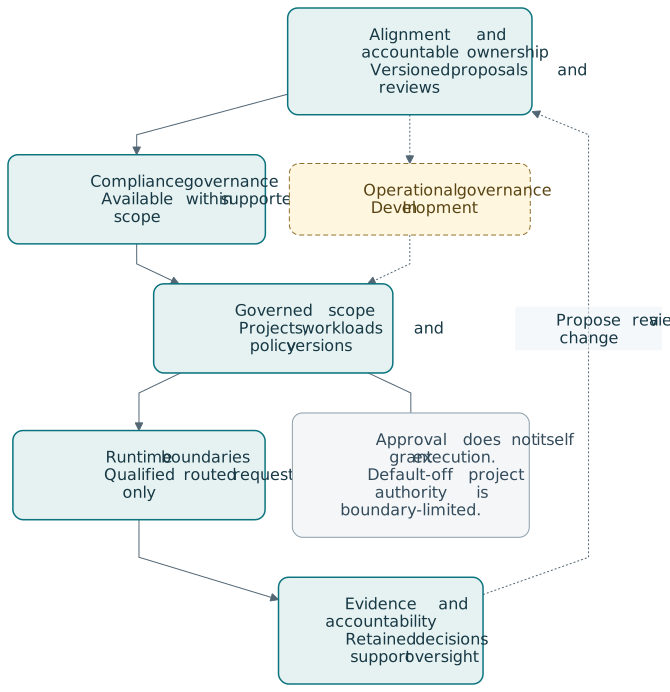
Organizational alignment and accountable scope connect to supported runtime controls and retained evidence. Operational extensions remain in development.
Conceptual relationship; organizational approval is not executable enforcement.
Read the diagram description
Organizational alignment and accountable scope connect to supported runtime controls and retained evidence. Operational extensions remain in development. Conceptual relationship; organizational approval is not executable enforcement.
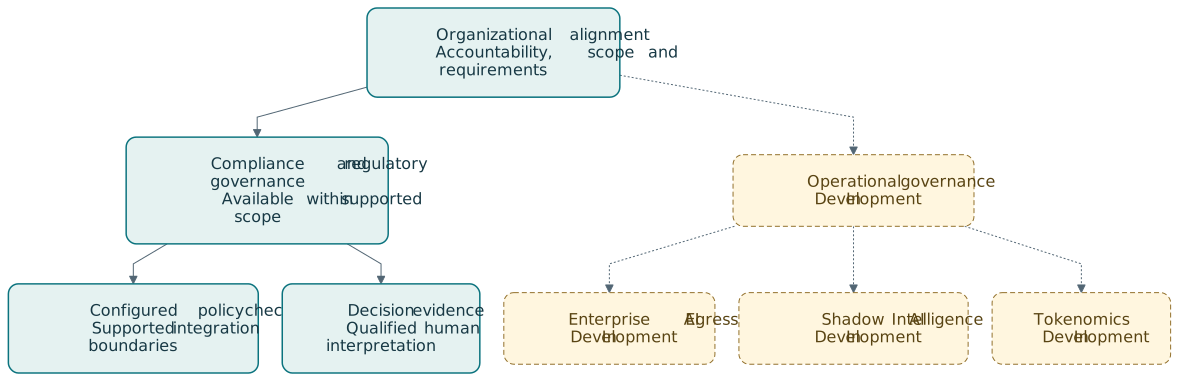
Compliance and regulatory governance uses scoped policies and evidence. Operational governance describes planned network, discovery and cost capabilities.
U.S.-first supported policy scope; no legal compliance certification.
Read the diagram description
Compliance and regulatory governance uses scoped policies and evidence. Operational governance describes planned network, discovery and cost capabilities. U.S.-first supported policy scope; no legal compliance certification.