
Foundations
Read capability and evidence status
Use maturity labels without treating them as permissions or deployment guarantees.
In this document
What the labels mean#
Status applies to the scope described in the capability record, not every possible use of its name. Available means the stated function exists in its supported environment; it does not promise that every tenant has it enabled or that a deployment is production-qualified.
- Available: implemented for the explicitly described boundary and access conditions.
- Demonstration: a teaching or evaluation experience whose fixture, simulated and measured elements remain distinct.
- In Development: incomplete, gated or not generally released in the described scope.
- Exploring: a direction or readiness activity without a released product commitment.
- Customer-Qualified: reserved for a defined customer environment and workload backed by actual qualification evidence. No such result is asserted by this catalog.
Status does not enable a feature#
A documentation label is not a feature flag, policy assignment, role grant or contract. Some implemented authority mechanisms are disabled by default and require an explicit rollout decision. A visible screen alone does not establish that its dependent services are enabled or that execution is permitted.
Conversely, disabling an authority feature after an application was enrolled cannot erase its obligations. Sticky enrolled scope must remain held rather than silently fall back to less restrictive authority.
Ask what was actually measured#
Independent research describes a study population. Controlled LSAS measurements describe a reproducible test. Synthetic data must be labeled as such; illustrative numbers must not be presented as measurements. Customer improvement requires an agreed baseline, denominator, period and acceptance method.
Evidence of a local test is useful for assessing a specific control. It is not evidence of general detection accuracy, enterprise coverage, clinical correctness, uptime, prevented breaches or realized savings.
Use the qualification statement#
Each capability lists its inputs, outputs, dependencies, evidence and limits. Read these together. The documentation verification date means the source description was reviewed on that date; it does not mean a production deployment or customer workload was retested then.
Capability registry
Organizational Alignment Available
Versioned governance intent, assigned independent review and explicit activation, with execution limits kept separate.
Supported environments: Authorized tenant console
Evidence: Proposal versions; Reviewer decisions; Audit events
Inputs: Seven-domain governance proposal; Current reviewer assignments; Attributed evidence references and attestations
Outputs: Versioned proposal and digest; Review decisions; Activation and change history
Dependencies: Current tenant membership; Supported lifecycle and validation rules
Controls: Server-derived authority; Exact-content approval binding; Author separation; Explicit activation
Security considerations: Tenant-scoped access; Current membership and assignment checks
Verified: 2026-11-06
Qualification: Implemented authoring and lifecycle controls; runtime applicability and deployment qualification remain separate.
- Active descriptive Alignment holds ordinary text and payload execution until its semantics have a supported executable adapter.
- A reference or attestation is not independent verification of source truth.
Projects and accountable ownership Available
A tenant project registry with current-member accountability, declared responsibilities, workload references and exception history.
Supported environments: Authorized tenant console outside managed evaluation configuration
Evidence: Immutable change events; Linked original assessment evidence; Event-time project evidence where recorded
Inputs: Project name and purpose; Current accountable member; Optional responsibility roles; Application/environment reference
Outputs: Stable draft project record; Revision history; Accountable exception responses
Dependencies: Current tenant membership; Configuration-manager authority for writes
Controls: Optimistic revision checks; Tenant-scoped workload uniqueness; Transactional audit and outbox
Security considerations: Managers manage; responsible members have scoped read access; Responsibility metadata does not grant approval permissions
Verified: 2026-11-06
Qualification: Registry and access boundaries qualified with synthetic PostgreSQL and console workflows; no enterprise inventory completeness claim.
- Registration remains draft and does not admit runtime traffic.
- Exception response does not alter the original policy result or automatically resume a held request.
Project-bound execution authorization In Development
A separately enabled, narrowly qualified authorization lifecycle for the deterministic payload boundary.
Supported environments: Explicitly enabled controlled environments
Evidence: Authorization and activation history; Canonical project context and release audit
Inputs: Exact project/workload/policy revisions; Owner acknowledgement; Independent officer decision; Manager activation; Bounded validity window
Outputs: Immutable authorization subject; Sticky application enrollment; Event-time execution context
Dependencies: Current owner and approver membership epochs; Supported payload-sanitize-v1 boundary; Server feature enablement
Controls: Independent owner/reviewer/activation responsibilities; Exact scope binding; Final authority refresh; Suspension and revocation hold
Security considerations: Default-off enablement; Enrolled applications cannot silently fall back to legacy authority
Verified: 2026-11-06
Qualification: Controlled local lifecycle, real disposable PostgreSQL concurrency and synthetic HTTP qualification; not general enterprise availability.
- No unrestricted agent, provider or financial authority.
- Disabling the feature holds enrolled workloads.
- Active unsupported Alignment still holds execution.
Delegated review administration In Development
Explicit time-bounded administration and immutable, independently reviewed four-role policies.
Supported environments: Explicitly enabled authorized console
Evidence: Immutable policy decisions; Assignment and delegation audit
Inputs: Platform-issued delegation; Current reviewer assignments; Versioned review-policy proposal
Outputs: Delegation history; Independent decisions; Effective review-policy revision
Dependencies: Server enablement; Current membership epochs; Four distinct reviewers
Controls: No self/onward delegation; No author approval; Expiry and revocation; Policy-change invalidation
Security considerations: Tenant scope; Role removal/rejoin does not revive old authority
Verified: 2026-11-06
Qualification: Implemented behind a default-off server flag; controlled qualification does not imply enabled customer access.
- Reduced-review policy activation is not qualified.
- Administrative delegation is not permission to approve another person's decision or change financial limits.
Self AI, Team AI and Managed AI In Development
Adoption contexts for explaining proportionate accountability; expanded profile configuration and contextual reporting are being developed.
Supported environments: Planning and scoped evaluation
Evidence: Scoped evaluation evidence, where available
Inputs: People, shared work and managed workload context; Intended control boundary
Outputs: Agreed governance scope; Proposed ownership and evidence requirements
Dependencies: Qualified integration; Organizational authority
Controls: Existing supported controls apply only where integrated
Security considerations: Context labels confer no permissions
Verified: 2026-11-06
Qualification: Explanatory architecture; expanded configuration and reporting remain In Development.
- These are contexts, not pricing tiers or automatically discovered estates.
- No broad profile reporting or universal end-user coverage is claimed.
Compliance and Regulatory Governance Available
Configured policy checks and evidence within supported integration boundaries, with legal interpretation kept separate.
Supported environments: Supported routed requests; Bounded assessments and evaluations
Evidence: Decision and final-boundary records
Inputs: Approved technical policy; Supported content; Reviewed scope
Outputs: Findings; Policy decisions; Enforcement evidence
Dependencies: Enabled validators; Exact policy assignment; Qualified integration
Controls: Input evaluation; Supported transformation and revalidation; Withholding; Traceable policy version
Security considerations: Identity and policy resolved server-side
Verified: 2026-11-06
Qualification: Available for supported evaluation and qualified integrations; no regulatory certification.
- Technical controls do not establish legal compliance or cover every obligation.
- Regulatory research coverage is not executable jurisdiction coverage.
Operational Governance In Development
An expanding operating model for AI observability, consumption and control across qualified organizational integrations.
Supported environments: Architecture and controlled development
Evidence: Current decision evidence only within supported boundaries
Inputs: Future qualified observation and usage sources; Ownership and integration inventory
Outputs: Planned operational visibility and reporting
Dependencies: Network and provider integrations; Attribution and completeness definitions
Controls: Existing Gateway controls remain bounded to routed requests
Security considerations: Unknown visibility must remain unknown
Verified: 2026-11-06
Qualification: Network-oriented harness, Shadow AI Intelligence and Tokenomics remain under development.
- No organization-wide observation or autonomous remediation is claimed.
- Dashboard illustration is not measured enterprise capacity.
Enterprise AI egress In Development
Planned enterprise egress integrations beyond the existing routed Gateway boundary.
Supported environments: Proposed customer network integrations
Evidence: Actual Gateway receipts, not inferred organization-wide coverage
Inputs: Qualified traffic sources; Destination inventory; Approved data boundary
Outputs: Planned observation and enforcement coverage
Dependencies: Actual traffic routing; TLS and identity design; Failure-mode qualification
Controls: Existing inline evaluation for supported routed traffic
Security considerations: Destination controls at the configured adapter boundary
Verified: 2026-11-06
Qualification: Existing Gateway is implemented; enterprise network harness integrations are not released.
- Not a universal network interception product.
- Traffic that bypasses an integration is outside its known enforcement coverage.
Shadow AI Intelligence In Development
Planned source-based discovery and attribution of AI use outside the approved operating model.
Supported environments: Future qualified integrations
Evidence: Source, observation time and confidence will be required
Inputs: Approved source records; Identity and application inventory
Outputs: Planned attributed observations and review queues
Dependencies: Source access; Attribution quality; Deduplication and coverage definitions
Controls: Human review of inferred observations
Security considerations: Least-privilege collection and data minimization
Verified: 2026-11-06
Qualification: Design direction; do not interpret existing Discovery Scanner findings as Shadow AI inventory.
- No current all-tool discovery capability.
- Observed traffic does not by itself prove unsanctioned use or identify the accountable person.
Tokenomics In Development
Planned usage, allocation and financial visibility with explicit measurement provenance.
Supported environments: Future qualified provider and billing integrations
Evidence: Usage/rate/source provenance required
Inputs: Observed usage; Versioned rates; Attribution and invoice context
Outputs: Planned consumption and allocation reporting
Dependencies: Provider-specific usage semantics; Currency and rate provenance; Financial ownership design
Controls: Separate actual, estimated and unavailable values
Security considerations: Financial responsibility metadata is not spending authority
Verified: 2026-11-06
Qualification: Existing usage metadata fields do not establish complete FinOps or realized savings.
- No released enterprise budget admission or invoice reconciliation.
- Missing usage is not zero; execution budgets are not monetary limits.
Runtime policy evaluation Available
Deterministic evaluation of supported ingress and egress content under exact assigned policies.
Supported environments: Qualified Gateway integrations; Controlled evaluation
Evidence: Policy/version and validator provenance; Final outcome and artifact digest
Inputs: Authenticated request; Supported text or JSON; Exact policy version
Outputs: Rule findings; Engine decision; Transformed or withheld artifact
Dependencies: Application identity; Policy resolution; Supported validators
Controls: Pre-effect evaluation; Server-side transformation; Revalidation; Final release checks
Security considerations: Unsupported input and authority fail closed
Verified: 2026-11-06
Qualification: Bounded route and adapter behavior tested; customer deployment remains separately qualified.
- Detection is scoped and heuristic.
- No complete de-identification, prompt-injection immunity or clinical validity claim.
Versioned policy packs Available
Bundled validator selection, rule weights and decision thresholds resolved by exact ID and version.
Supported environments: Configured tenant/application/environment
Evidence: Effective pack ID/version; Rule and validator identifiers
Inputs: Approved pack assignment; Validator findings
Outputs: Weighted policy decision; Version provenance
Dependencies: Installed pack and validator versions
Controls: Role-protected assignment; Ambiguous/missing authority rejection
Security considerations: Client headers cannot select arbitrary production authority
Verified: 2026-11-06
Qualification: Bundled technical catalog is implemented; new controls and jurisdiction packs need explicit qualification.
- A pack name is not a certification.
- A Pulse dossier or proposed jurisdiction mapping is not automatically an installed runtime pack.
Bounded execution controls Available
Registered skills, constrained transport and exact final-publication checks for supported operations.
Supported environments: Supported Gateway and connector boundaries
Evidence: Intent and terminal audit records; Final artifact fingerprint where applicable
Inputs: Server-resolved authority; Registered skill/action; Permitted destination and schema
Outputs: Admitted or held execution; Canonical terminal evidence
Dependencies: Known adapter; Current credential and authority state
Controls: Deadline/cancellation checks; Scope and destination binding; Atomic terminal publication
Security considerations: Proposals cannot expand grants; Unknown effects require reconciliation
Verified: 2026-11-06
Qualification: Qualified mechanisms apply to enumerated boundaries only, with separate simulated paths.
- Not arbitrary agent orchestration or universal tool execution.
- Final commit authorizes preparation/release; it is not proof of external delivery.
Exact-output nonclinical review Available
Opt-in, time-bounded review of a retained exact output for supported nonclinical applications.
Supported environments: Explicitly enrolled nonclinical applications
Evidence: Review view and decision records; Release evidence
Inputs: Held artifact; Current reviewer authority; Original application audience
Outputs: Approve/reject/revoke history; Eligible release to the original audience
Dependencies: Supported review profile; Unexpired original grant; Encrypted artifact storage
Controls: Exact artifact and context binding; Expiry and revocation; Original audience restriction
Security considerations: Held content excluded from ordinary telemetry
Verified: 2026-11-06
Qualification: Implemented for the named nonclinical profile; integration and data handling require qualification.
- Not clinical approval or general task resume.
- A HELD result does not prove a reviewer saw or approved anything.
Decision evidence and exports Available
Tenant-scoped canonical outcomes, policy provenance and correlated exports with explicit missing/conflicting states.
Supported environments: Authorized console and evaluation workspace
Evidence: Request ID; Policy/version; Outcome/stage; Artifact digest
Inputs: Canonical decision; Terminal audit/outbox; Scoped filter
Outputs: Decision detail; JSON/HTML/PDF evidence where supported; Conflicts and unknowns
Dependencies: Retained evidence; Current read authorization
Controls: Shared projection for totals and excerpts; Event-time context validation; No fabricated missing receipts
Security considerations: Tenant and audience scoping; Derived evidence rather than unrestricted raw payloads
Verified: 2026-11-06
Qualification: Local reconciliation and negative tests support the stated projection; external custody is not certified.
- Hashes are not anonymization or independent attestation.
- Some diagnostic and exact-output review storage has a separate raw-content boundary.
Governance reporting Available
Scoped final outcomes and evidence views with defined windows, excerpts and provenance.
Supported environments: Authorized tenant console; Publication-filtered demonstration telemetry
Evidence: Source and time window; Final outcome versus earlier decision
Inputs: Retained canonical and qualified legacy records
Outputs: Outcome totals; Bounded detail excerpts; Evidence exports
Dependencies: Shared report projection; Publication scope for public data
Controls: Conflict exclusion; Deduplication; Explicit scope and freshness
Security considerations: Public telemetry excludes private tenant data
Verified: 2026-11-06
Qualification: Supported reporting projections tested; customer metrics require agreed denominators and retention scope.
- Displayed totals are not complete enterprise inventory.
- Unavailable data is not a zero result; event timestamps are not end-to-end latency measurements.
Structured governance assessment Available
Durable assessment of structured cases, with explicit evidence limits and accountable follow-up.
Supported environments: Authorized tenant assessment workspace
Evidence: Assessment inputs and results within authorized storage scope
Inputs: Supported structured case; Declared context and evidence references
Outputs: Assessment findings; Retained assessment record; Linked exception follow-up
Dependencies: Validated input shape; Tenant authorization; Supported deterministic assessment
Controls: Durable scoped processing; Structural validation; History retention
Security considerations: Scoped access and separate uploaded-material retention
Verified: 2026-11-06
Qualification: Implemented deterministic assessment path; do not imply unrestricted model-based reasoning.
- Structural support is not factual grounding or clinical correctness.
- The assessment model broker and authoritative retrieval remain separate unfinished capabilities.
Governance Workbench Demonstration
Public no-code exploration of supported policy decisions, governed outputs and inspectable evidence.
Supported environments: Public configured demonstration workspace
Evidence: Request-correlated demonstration records
Inputs: Guided synthetic scenario; Supported non-sensitive custom JSON; Explicit connector mode
Outputs: Observed policy result; Governed output; Demonstration evidence and telemetry
Dependencies: Configured demo policy and workspace
Controls: Server-selected guided fixtures; Enforced custom content; Explicit simulation labels
Security considerations: Demo identity remains separate from signed-in private tenant identity
Verified: 2026-11-06
Qualification: Controlled local behavior and presentation qualified; production customer integrations are not inferred.
- Simulated FHIR/override views are not real provider effects or production approvals.
- Use synthetic or non-sensitive data.
Developer Evaluation Available
A private, bounded technical evaluation with controlled payload, scenario and supported action exercises.
Supported environments: Enabled hosted or qualified local evaluation workspace
Evidence: Actual local evaluation receipts; Separated fixed-provider scenarios
Inputs: Verified enrollment; Scoped evaluation key; Synthetic or non-sensitive test cases
Outputs: Governed HTTP results; Owner-scoped evidence; Downloaded exercises and reports
Dependencies: Evaluation availability; Activation, quota and expiry rules
Controls: Server-selected policy choices; Shared quota; Ownership and expiry enforcement
Security considerations: Write-only raw keys; Owner-scoped reports; Managed workspace configuration
Verified: 2026-11-06
Qualification: Existing actual HTTP acceptance covers synthetic evaluation boundaries; customer outcomes remain unmeasured.
- No production entitlement, unrestricted provider calls or unlimited traffic.
- Application-kit callback effects are local and bounded; they do not qualify arbitrary tools.
Discovery Scanner Available
Restricted-distribution local assessment of approved files, with separately qualified source-connection options.
Supported environments: Supported native Windows x64 and macOS Intel packages; Agreed customer assessment scope
Evidence: Assessment source and finding references
Inputs: Approved local files; Optional separately configured SQL Server source
Outputs: Local assessment report; Findings and coverage gaps
Dependencies: Matching release/package qualification; Source permissions and supported formats
Controls: Read-only collection scope; Local evaluation; Customer-controlled report sharing
Security considerations: No automatic result upload in the offline offering; Least-privilege source access
Verified: 2026-11-06
Qualification: Available through a scoped engagement; native artifact, customer driver and source qualification remain specific.
- Findings do not remediate source data or enforce live AI traffic.
- SQL Server and separate PostgreSQL CLI capabilities must not be conflated with every native workspace source type.
Regulatory Pulse Available
U.S.-first, source-referenced state legislative research with published coverage and maturity distinctions.
Supported environments: Public source inventory and reviewed publication paths
Evidence: Source links; Retrieval and publication context
Inputs: Published state source records; Official links and provider metadata; Reviewed obligations where available
Outputs: Source inventory; Legislative status context; Reviewed mappings where published
Dependencies: Source retrieval and publication workflow; Human interpretation and applicability review
Controls: Publication-scoped data; Source/status/date distinctions
Security considerations: Draft/private records excluded from public projection
Verified: 2026-11-06
Qualification: Published state inventory is implemented; source-to-obligation-to-execution completeness varies by reviewed record.
- State count is not executable pack count or compliance coverage.
- No federal, global or automatically current legal coverage claim.
- Applicability is not inferred from IP address or selected state.
Provider and connector adapters Available
Bounded text-provider adapters and explicitly scoped connector paths.
Supported environments: Qualified tenant provider configuration; Authorized Epic sandbox read/search; Network-free simulated connectors
Evidence: Provider/context metadata and supported terminal receipts
Inputs: Approved endpoint; Tenant-bound secret reference; Supported operation
Outputs: Untrusted upstream result for egress evaluation; Transport and execution evidence
Dependencies: Network and credential qualification; Known adapter contract
Controls: HTTPS destination admission; Redirect rejection; Bounded bytes/retries/deadlines; Tenant-bound credentials
Security considerations: Authenticated encryption for supported stored provider secrets; No provider key in public evidence
Verified: 2026-11-06
Qualification: Adapter contract tests do not prove every upstream model or deployment works.
- No universal provider API compatibility, general MCP/tool gateway or clinical write support.
- Real upstream and customer networks need separate qualification.
Private deployment Available
A scoped delivery and shared-responsibility engagement for an agreed customer-controlled environment.
Supported environments: Agreed customer VPC or on-premises topology
Evidence: Agreed deployment acceptance records
Inputs: Deployment scope; Infrastructure and identity requirements; Acceptance and support agreement
Outputs: Agreed deployment package and installation plan; Environment-specific qualification evidence
Dependencies: Customer infrastructure; PostgreSQL operations; Network and secret provisioning
Controls: Versioned installation and migration plan; Defined update/backup/incident ownership
Security considerations: Customer-specific network and data-flow review
Verified: 2026-11-06
Qualification: Offered through a coordinated engagement; no customer-specific qualification is asserted by this catalog.
- Not an automatically qualified topology or a promise of air-gapped operation.
- External providers/connectors may cross the deployment boundary.
Enterprise scale qualification In Development
Workload-specific validation of throughput, concurrency, recovery and operating coverage.
Supported environments: Controlled tests and future customer qualification
Evidence: Per-run receipts and source versions where measured
Inputs: Representative workload; Integration inventory; Latency and recovery acceptance criteria
Outputs: Measured qualification results where actually run
Dependencies: Defined topology; Representative data; Instrumented load and failure tests
Controls: Explicit denominators and test conditions; Separation of illustration and measurement
Security considerations: Capacity must preserve isolation and fail-closed behavior
Verified: 2026-11-06
Qualification: No customer-qualified scale result is claimed; qualification is required for the intended workload.
- The enterprise-scale website example uses illustrative data, not a capacity benchmark.
- No supported agent-count, latency or availability guarantee follows.
Security and trust boundaries Available
Implemented identity, tenant isolation, secret and release controls with documented operational limits.
Supported environments: Supported application and Gateway paths
Evidence: Boundary tests and scoped audit records
Inputs: Authenticated identity; Authorized tenant/app scope; Configured secrets and destinations
Outputs: Scoped decisions and protected evidence
Dependencies: Secure deployment configuration; Session/key lifecycle; Current software releases
Controls: Server-side authorization; Revocation and expiry; Constrained outbound requests; Atomic evidence publication
Security considerations: Defense depends on enabled integrations and deployed operations
Verified: 2026-11-06
Qualification: Implemented controls require deployed configuration, recovery and independent assessment for intended use.
- No assertion of breach prevention, universal security or certification.
- Uploaded material, diagnostic snapshots and held review artifacts have distinct retention and access boundaries.
Independent assurance readiness Exploring
Early SOC 2 readiness discussions with Vanta; no completed attestation is claimed.
Supported environments: Assurance planning
Evidence: User-confirmed early Vanta discussions; no audit report supplied
Inputs: Proposed control scope; Operating evidence and auditor requirements
Outputs: Readiness planning, when agreed
Dependencies: Defined audit scope; Operating-period evidence; Independent auditor work
Controls: Claims separated from independent attestation
Security considerations: Readiness tooling is not an auditor opinion
Verified: 2026-11-06
Qualification: Planning fact supplied and approved by the owner; no certification evidence inferred.
- LSAS does not claim SOC 2 Type I/II attestation, ISO certification or equivalent external assurance.
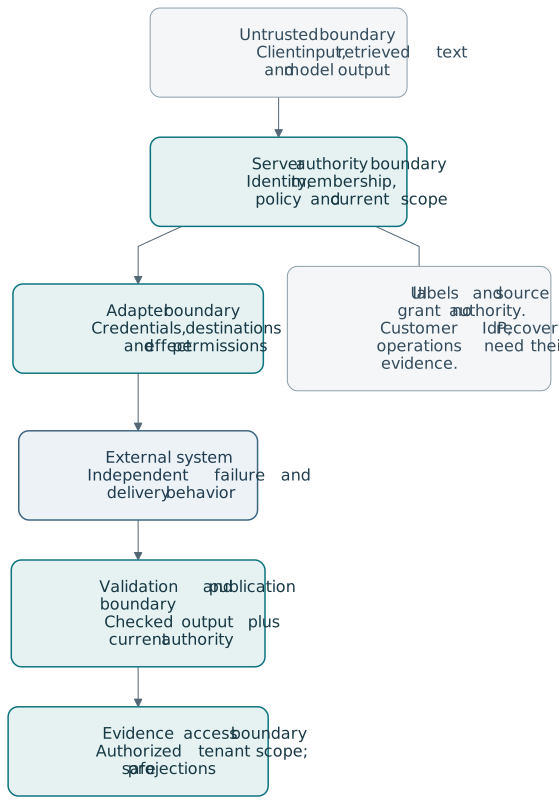
Untrusted clients and content cannot grant authority. Server authorization, qualified adapters and scoped evidence each have separate responsibilities.
Architecture boundaries; no certification or complete customer-environment qualification claim.
Read the diagram description
Untrusted clients and content cannot grant authority. Server authorization, qualified adapters and scoped evidence each have separate responsibilities. Architecture boundaries; no certification or complete customer-environment qualification claim.