
Governance dimensions
Compliance and Regulatory Governance
Translate reviewed requirements into scoped technical controls and evidence.
In this document
Govern a supported boundary#
Compliance and Regulatory Governance combines configured policies, supported runtime controls and decision evidence. A policy may identify a pattern, require a transformation, block an artifact or hold it for a supported review path. Its effect depends on the actual integration and enabled validators.
A policy pack's regulatory name describes its technical intent. It does not establish that all requirements of a law, framework or clinical setting have been implemented or that a particular organization is compliant.
Keep interpretation accountable#
Begin with the actual source requirement and its applicable dates. A qualified person reviews applicability and records the organizational interpretation. Organizational Alignment can record intent and responsible review; a technical policy requires its own supported mapping and version.
Regulatory Pulse helps locate source-referenced state material and reviewed mappings where available. Introduced bills, enacted law and effective obligations are distinct. Source tracking alone neither determines applicability nor activates a runtime pack.
Inspect what the control established#
For a supported request, inspect the selected policy version, findings, engine decision, final outcome and actual transformed or withheld artifact. Verify that the report agrees with authoritative evidence. A BLOCKED decision is not a prevented breach, and a complete evidence record is not complete regulatory compliance.
- Requirement and interpretation: who reviewed it and for which business context?
- Technical control: which supported behavior implements the interpretation?
- Execution evidence: what actually happened under the effective version?
- Remaining obligation: what needs human, organizational or external action?
Carry unresolved obligations forward#
Some requirements concern processes, notices, contracts, employee training or oversight outside a request boundary. Keep them visible as unresolved organizational obligations. Do not replace them with a green runtime result or infer that one successful integration governs every workflow.
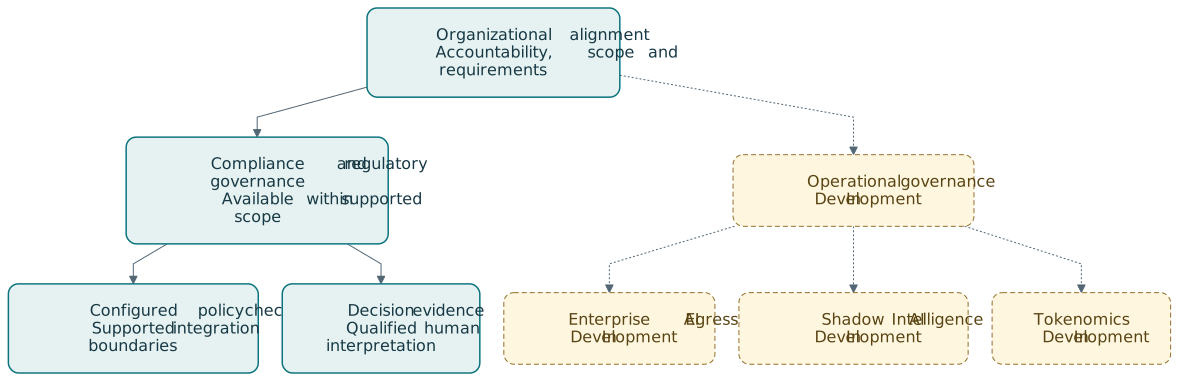
Compliance and regulatory governance uses scoped policies and evidence. Operational governance describes planned network, discovery and cost capabilities.
U.S.-first supported policy scope; no legal compliance certification.
Read the diagram description
Compliance and regulatory governance uses scoped policies and evidence. Operational governance describes planned network, discovery and cost capabilities. U.S.-first supported policy scope; no legal compliance certification.
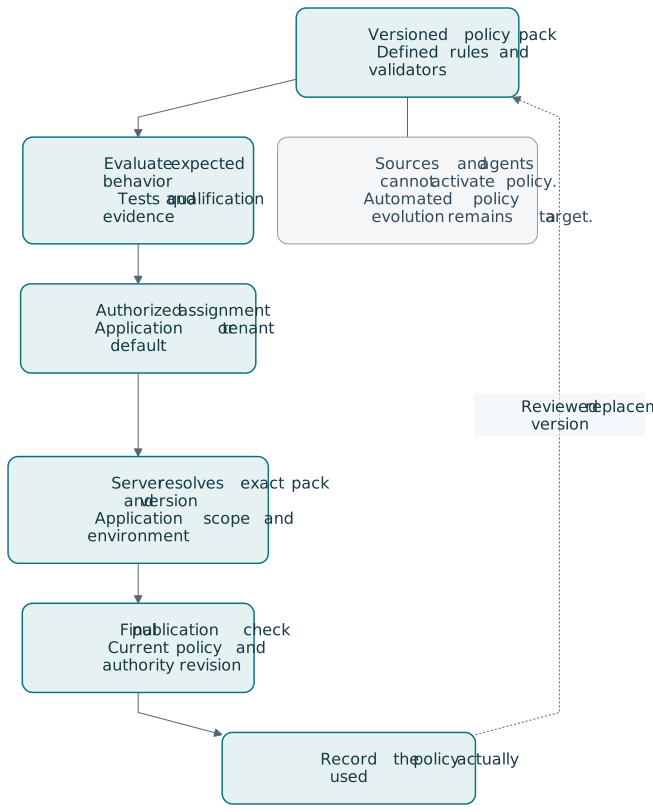
A versioned policy is evaluated and explicitly assigned; the server resolves the exact applicable binding and rechecks it before release.
Current version binding; autonomous source-to-policy promotion is not implemented.
Read the diagram description
A versioned policy is evaluated and explicitly assigned; the server resolves the exact applicable binding and rechecks it before release. Current version binding; autonomous source-to-policy promotion is not implemented.
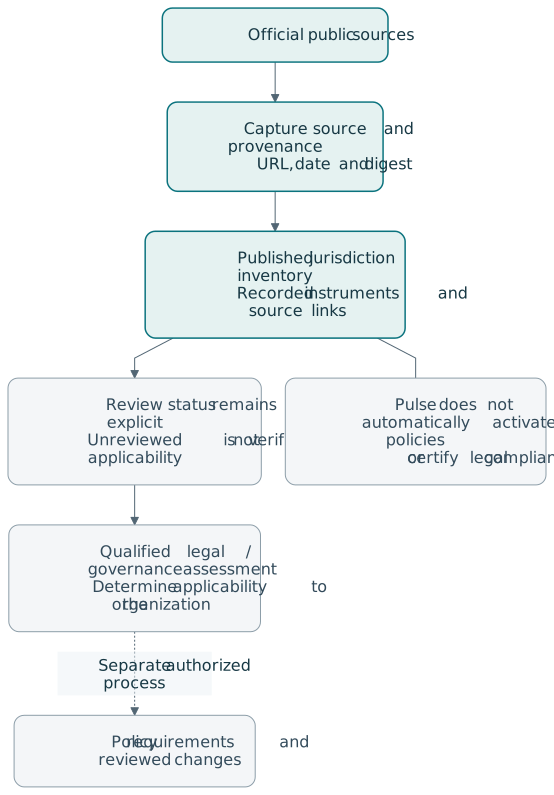
Official source records support a bounded published inventory. Review and applicability are separate from collection and publication.
Research inventory; a source record or enacted instrument is not an implementation obligation.
Read the diagram description
Official source records support a bounded published inventory. Review and applicability are separate from collection and publication. Research inventory; a source record or enacted instrument is not an implementation obligation.