
AI GOVERNANCE THAT ACTS
Your teams want AI.Your board wants control.LSAS Platform gives you both.
Connect organizational authority to AI execution. Define what AI is allowed to do, enforce policy at supported runtime boundaries, and inspect the evidence behind each governed decision.
Free exploration with synthetic or non-sensitive data.
Request a DemoWhat does governed at runtime look like?
Move AI forward.
Enable teams to evaluate AI within defined operational boundaries.
Control what matters.
Allow, transform, block, or hold supported operations according to configured policy.
Show the evidence.
Inspect policy outcomes, decision records, and coverage limitations.
Explore LSAS Platform
See governance in action. Your way.
Two free ways to explore. Choose the experience that fits your role; start with either one.
Watch the Developer Evaluation walkthrough 3 min 12 sec · Captioned
From signup to your first governed result
See the local exercise, private console, and evidence export before you start.
Walkthrough: real local execution with synthetic data; simulated email delivery. Not customer activity.
Evaluating LSAS Platform for your organization?
Request a guided demo to discuss your workflows, governance priorities, and deployment requirements with our team.
Organizational Alignment
Govern the Right Things. Not Just the Things You've Configured.
An organization can have policies and controls in place and still lack agreement on what should be governed. LSAS Platform Organizational Alignment connects leadership priorities, governance responsibilities, approved boundaries and policy authorization through versioned proposals, assigned reviewers and explicit activation.
Drafting, approval and activation are distinct. Runtime enforcement depends on the supported execution integration.
Explore runtime authorityREGULATORY PULSE
AI regulation, with the evidence in view.
Explore state AI legislation, understand key legal milestones, and trace reviewed obligations to mapped controls. Regulatory Pulse helps engineering, governance and legal teams see the evidence, assess coverage and identify the work ahead.
- Explore by state, industry and AI use case.
- Inspect source references and legal milestones.
- Review control mappings and coverage gaps.
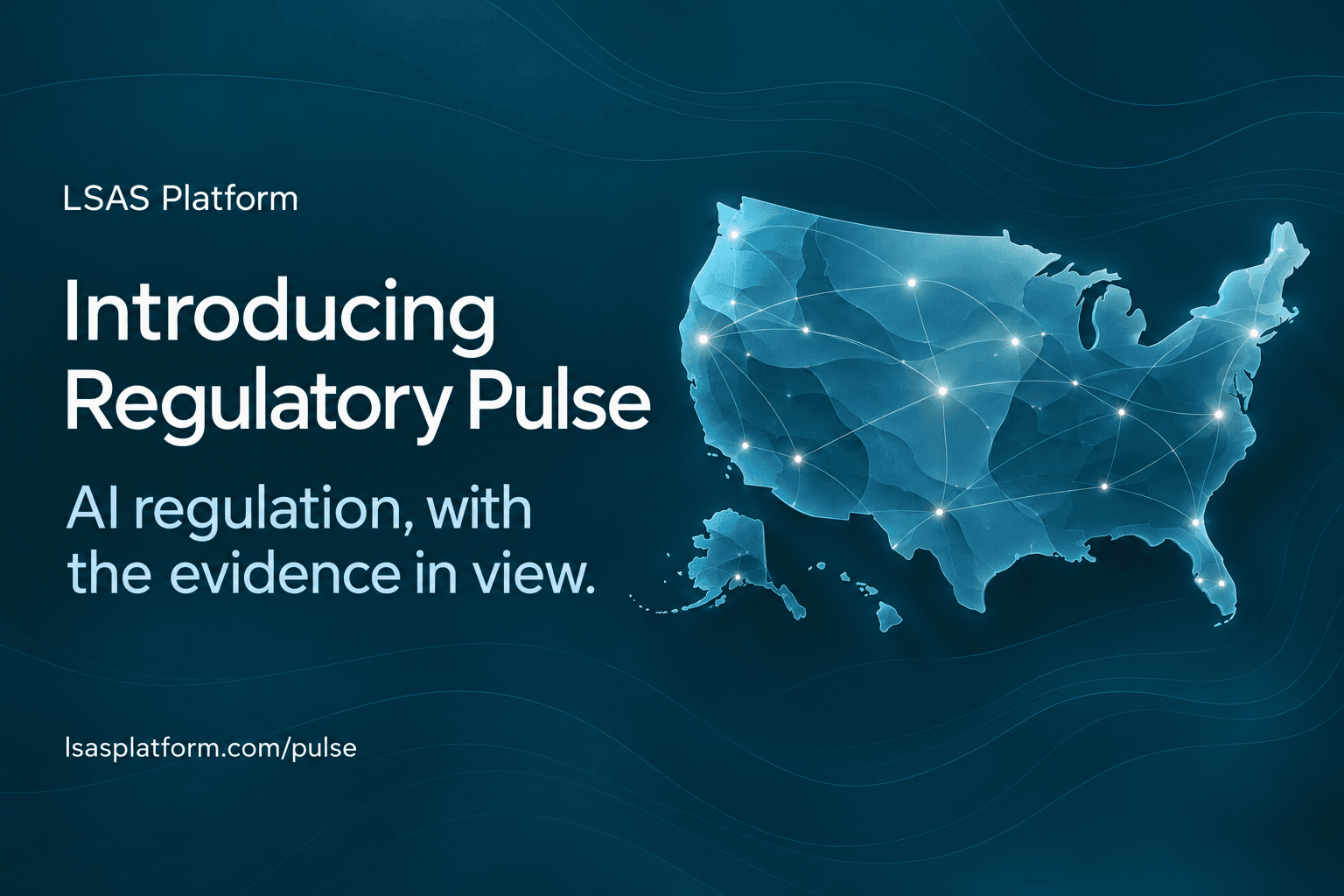
Coverage varies by state. Regulatory Pulse supports research and review; it does not provide legal advice or determine compliance.
A runtime governance platform in controlled enterprise rollout. Explore supported capabilities and deployment scope.
Discovery Scan
See LSAS Platform work on your data before you commit to a pilot.
Apply real LSAS Platform policy checks to your approved data. Get executive findings, clear coverage gaps, and a practical recommendation for what to address next.
Read-only assessment. Local reports. No live AI integration required. Review what the selected policies find, what remains unassessed, and where a pilot should focus.
Discovery
Starting at
$15,000
Up to 3 environments
Includes 4 hours of technical support per engagement.
Expanded Discovery
Starting at
$22,500
Up to 6 environments
Includes 8 hours of technical support per engagement.
One business. One agreed assessment scope. Both options include an executive readout and one same-scope follow-up scan. Support allowances are separate from these engagement deliverables.
Download the Discovery brief (PDF) (opens in a new tab)Live Sandbox Feed
Live telemetry from our public demo environment. Model calls, connector observations, and simulated override events are tracked as separate streams. Counts reflect demo traffic — published so you can inspect the control plane before you pilot it.
Demo scenarios are deliberately adversarial — high intervention rates are expected. Counts reflect live sandbox activity, not production traffic.
Snapshot available. Updated .
Policy outcomes from demo traffic
This panel summarizes policy decisions from the explicitly published demo application. Model/API and connector baseline observations are shown separately. Synthetic scenarios and simulated overrides illustrate how the controls behave. Their counts describe the demonstration — not production incident rates.
- Recorded evaluations
- 4,072
- Retained published demo activity
- Policy interventions
- 1,480
- blocked, redacted, escalated, or abstained
- Simulated overrides recorded:
- 1
- Allow rate (demo traffic):
- 64%
- allow or allow-with-warnings decisions
Totals reflect the scope shown on each card; charts use the displayed time window. An allow decision means the request satisfied your policy — it is a governance record, not an independent safety certification.

Intervention rate vs available history
Change vs history
2 pts down
Highest evaluated domain score
Most active rule (last 24h)
HIPAA_EMAIL
Fired 16 times across demo traffic.
Derived model/API evaluation telemetry from the explicitly published demo application. Covers available records in the last seven days.These scores are policy signals, not verified customer incidents.
Framework capabilities
Explore the evaluation platform
Connected surfaces for alignment, policy evaluation, and runtime governance. Implementation scope and qualification evidence are documented separately.
- Tenant-level provider configuration with encrypted, destination-bound credentials and bounded transport.
- Retention configuration, legal holds, and bounded cleanup through the separately operated worker.
- API key expiry, revocation, role-scoped administration, and conflict-safe updates.
- Epic sandbox patient read/search with distinct baseline observations and governed release behavior.
- Simulated Sandbox overrides, separate from protected approval of exact nonclinical output artifacts.
- Durable assessment execution with leases, cancellation, and scoped report exports.
Pipeline
How LSAS Platform works
The runtime binds supported execution to authority and policy. The wider specification also describes grounding and policy evolution capabilities that require further implementation and qualification.
Step
01
Resolve Authority
Resolve the authenticated application, active policy, alignment, provider destination, and permitted capabilities.
Step
02
Inspect Input
Validate supported text and payload shapes and check configured risk patterns before an external call.
Step
03
Bound Execution
Bind registered skills to an explicit grant, destination, deadline, and budget. Unsupported capabilities cannot expand that grant.
Step
04
Enforce Thresholds
Evaluate the actual result with supported validators and transformations. Record required obligations separately from completed controls.
Step
05
Decide at Runtime
Release eligible output or hold it. The bounded nonclinical review profile requires approval of the exact artifact before release.
Step
06
Record the Decision
Capture rule findings, policy context, and execution receipts. A successful check is evidence of that control, not proof that a claim is true.
Runtime surface
What LSAS Platform gives you
Deterministic decisions, risk-aware routing, and incident-ready telemetry, as a shared runtime layer in front of models, APIs, and system-of-record boundaries.
Decisioning
Deterministic outcomes
Supported evaluations produce an outcome, findings, and required actions. Authentication, validation, and infrastructure failures remain explicit errors.
Risk domains
Domain-specific guardrails
Configurable packs organize supported pattern and structural checks across risk domains. A HIPAA or FDA label does not establish regulatory completeness or clinical validity.
Insights
Decision telemetry
Decision records, scoped views, and worker-generated rollups help teams investigate observed behavior. Coverage and retention define their limits.
Regulated workloads
Evaluate boundaries for consequential workflows
Explore relevant control patterns with synthetic data. Production use requires qualification of the specific workflow, deployment, and operating responsibilities.

Medtech & Clinical Workflows
Explore PHI pattern checks and system-boundary behavior with the Epic sandbox patient read/search demonstration. Baseline observations and governed responses show different, intentional release conditions.
No clinical validation, medical-device qualification, or authorization for patient-impacting actions is asserted.

Fintech & Payment Workflows
Evaluate card-number and secret patterns in supported text and payloads. Inspect policy outcomes and transformations before integrating a particular financial workflow.
Designed to support governed payment and financial workflows, not replace internal risk, compliance, or security review.

Legal & Advisory Workflows
Assess the structure of supplied evidence and accountability records. Exact-artifact nonclinical review can hold eligible text for an assigned reviewer. Source authenticity, legal correctness, and claim support require separate verification.
Designed to govern AI behavior in legal and professional contexts, not to replace legal judgment or professional review.
Why LSAS Platform
Connect authority, execution, and evidence.
A shared framework for examining which controls ran, what they authorized, and where human or deployment-specific evidence is still needed.
LSAS Platform connects organizational alignment with deterministic checks and bounded runtime execution. Registered specialists operate within explicit authority; their output cannot grant new permissions or activate a policy change.
The wider specification includes authoritative grounding and governed policy evolution. Those capabilities are tracked separately from implemented pattern checks, structural assessments, and the bounded output-review profile.
FAQ
Enterprise FAQ
Get detailed answers across product capabilities, model/provider support, healthcare system-boundary governance, implementation approach, and pricing expectations.
Built for deeper evaluation
The full FAQ covers 20+ enterprise-focused questions, including provider compatibility (OpenAI-compatible and Anthropic adapters, plus separately evaluated integrations), control boundaries, evaluation milestones, deployment models, and what teams should expect during implementation.
FAQ Hub
Browse by category or use search to quickly find implementation and governance answers.